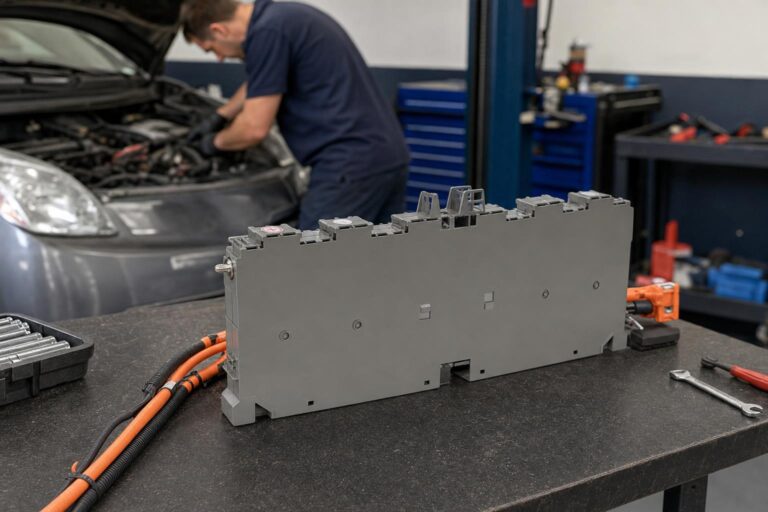
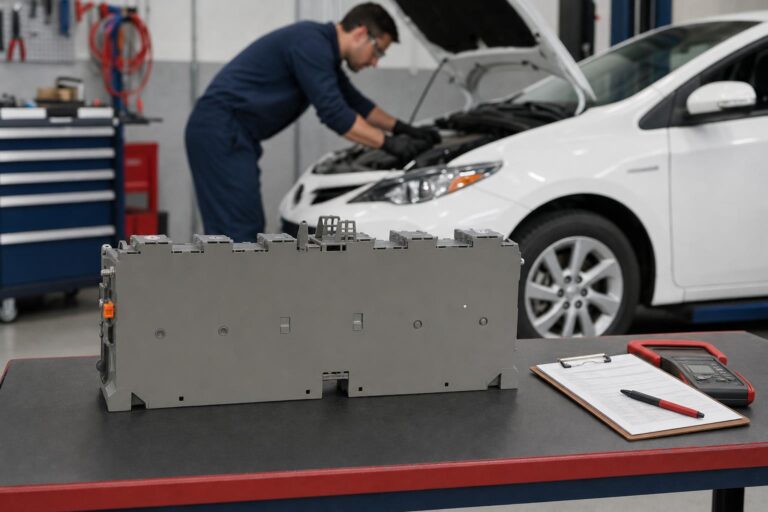
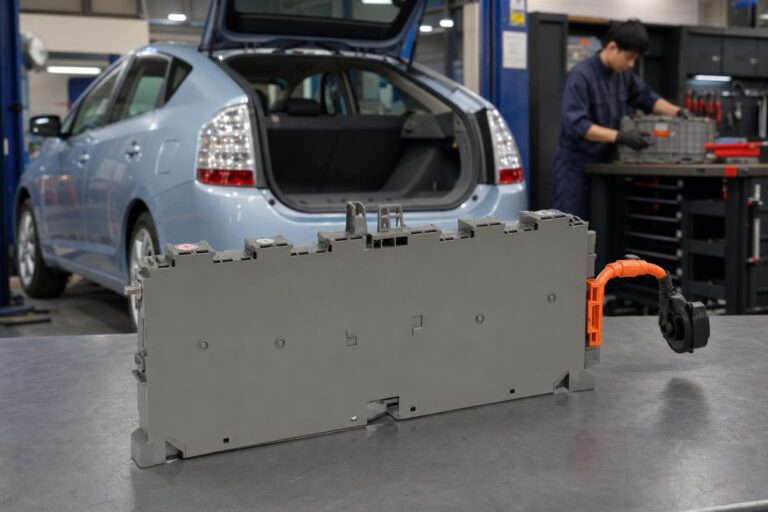
विश्वसनीय हाइब्रिड बैटरी समाधान



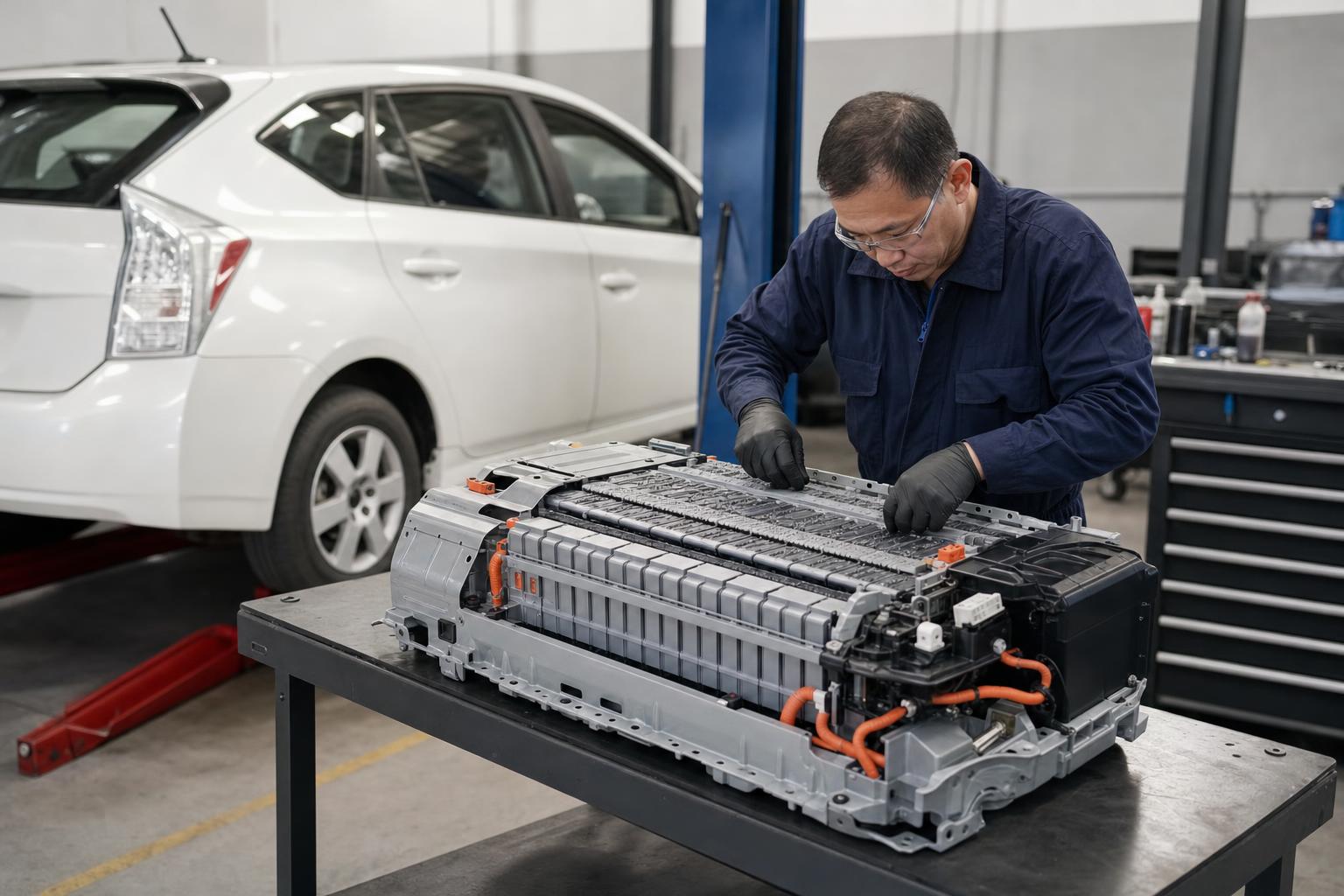
टोयोटा प्रियस हाइब्रिड बैटरी की कीमत मॉडल वर्ष के अनुसार: 2001-2018 के लिए जनरेशन 1 से जनरेशन 4 तक की कीमत श्रेणियां
A generation-by-generation guide to Toyota Prius hybrid battery replacement prices for 2001–2018 models, explaining why dealer, independent-shop, remanufactured, salvage and new OEM-spec NiMH quotes vary so widely.
 द्वाराOkacc हाइब्रिड बैटरी

As of an October 2026 cost guide, replacing a Toyota Prius hybrid battery typically runs about $2,000–$3,500 at an independent hybrid shop और $3,500–$5,500 at a Toyota dealer, parts and labour included. A reconditioned pack can be installed for as little as $1,300–$2,500 but usually carries a shorter warranty. The exact figure for a given car depends far more on the generation, pack type and sourcing channel than on the single model year printed on the registration. This guide breaks the Toyota Prius 2007 hybrid battery price question — and every model year from 2001 to 2018 — into clear cost bands so repair shops, fleet operators, importers and parts resellers can compare options before committing.
The traction battery (also called the hybrid battery or high-voltage battery) is the large nickel-metal-hydride (NiMH) pack that powers the electric side of the Prius hybrid system. It is separate from the small 12V auxiliary battery. When it degrades, the dashboard commonly shows a red triangle warning and a stored पी0ए80 “Replace Hybrid Battery Pack” code. That failure point is where almost all the pricing research in this cluster begins.
चाबी छीनना
- Prius hybrid battery price is driven by generation and sourcing channel, not just the model year.
- Installed quotes commonly span roughly $800 for a salvage pack to $5,500+ for a dealer OEM job.
- Older Gen 1 and Gen 2 cars (2001–2009) often sit near the “replace, rebuild or scrap” decision line because remaining vehicle value is limited.
- A new OEM-spec NiMH pack reduces the warranty and return-rate risk that reconditioned or salvage units carry for resale and installation businesses.
- Always confirm whether the car still has factory hybrid-component warranty before paying out of pocket.
Why Prius hybrid battery price varies so much by year and generation
Two cars built a year apart can attract very different quotes, so it helps to understand what actually moves the number:
- Generation and pack architecture. The Prius spans four generations, each with its own module count, voltage and physical pack design. Parts are not interchangeable across generations.
- पैकेज का प्रकार। Most Prius models use NiMH. Some later Gen 4 trims use lithium-ion, which changes part cost.
- Sourcing channel. Dealer OEM, independent hybrid specialist, remanufactured, salvage and new OEM-spec aftermarket all price differently.
- Labour and local rates. Pack replacement labour is usually a few hundred dollars, but shop rates and diagnostic time vary by market.
- Core charges and freight. Returning the old pack and shipping a high-voltage battery across borders add cost that is easy to overlook.
Because of this, a year-specific question — the 2015 or 2006 model year, for example — is best answered as a range tied to generation and channel rather than a single figure. If you procure across several Toyota hybrid platforms, it also helps to benchmark against the breadth of a supplier’s हाइब्रिड बैटरी उत्पाद श्रृंखला before narrowing to one model year.
Price snapshot by generation and model year
The table below consolidates installed cost bands reported by independent cost guides. All bands reflect third-party 2026 market data and may shift over time; treat them as references, not guarantees. The dealer-OEM figures are the overall Prius dealer range from the cited guide rather than a per-generation quote.
| पीढ़ी | मॉडल वर्ष | New pack (independent, installed) | Dealer OEM (installed, overall Prius range) |
|---|---|---|---|
| Gen 1 | 2001–2003 | Often quoted alongside Gen 2 options where available | Frequently discussed as a “replace or scrap” case due to vehicle value |
| Gen 2 | 2004–2009 | ~$2,000–$4,000 | ~$3,500–$5,500 |
| Gen 3 (incl. Prius V) | 2010–2015 | ~$2,200–$4,500 | ~$3,500–$5,500 |
| Gen 4 | 2016–2018 | ~$2,800–$5,500 (NiMH or Li-ion by trim) | ~$3,500–$5,500+ |
These Gen 2, Gen 3 and Gen 4 new-pack figures are drawn from the RepairPriceLab October 2026 breakdown.
Gen 1 Prius (2001–2003) battery cost considerations
The first-generation Prius (NHW11 in most export markets) uses an early NiMH pack, and mainstream new supply for this generation is limited compared with later models. Buyers researching battery options for 2001, 2002 or 2003 cars will often find remaining vehicle value is low. For these cars the honest conversation is frequently “replace, rebuild or scrap” rather than a straightforward new-pack install. Where a replacement is still worthwhile — for example a well-kept example or a specific fleet need — a new OEM-spec NiMH pack is the lower-risk path versus a used salvage unit of similar age.
Gen 2 Prius (2004–2009) — including 2005, 2006 and 2007 pricing questions
This generation drives many of the highest-volume pricing searches in this cluster, from 2004, 2005 and 2006 replacement-cost questions to the lead Toyota Prius 2007 hybrid battery price query and broader Gen 2 battery replacement research. The NHW20 Gen 2 pack is a well-understood NiMH design, and new packs are typically quoted around $2,000–$4,000 installed at an independent specialist, versus the broader $3,500–$5,500 dealer range cited above. Because these cars are now 15+ years old, the decision frequently hinges on how long the owner intends to keep the vehicle.
Gen 3 Prius (2010–2015) — including 2013 and 2015 pricing, plus Prius V
Pricing questions for the 2013 and 2015 model years — and for the Prius V wagon — all map to the Gen 3 ZVW30 platform and the larger Prius V (ZVW40/41) body style. New-pack installed pricing is typically around $2,200–$4,500 independently and $3,500–$5,500 at a dealer. The Prius V uses a larger, heavier pack than the standard liftback, so quotes at the upper end of the band are common for V models and should be confirmed against the specific part for the body style.
Gen 4 Prius (2016–2018) NiMH vs Li-ion pack cost differences
Replacement questions for the 2016, 2017 and 2018 model years fall in the fourth generation (ZVW50). Here, pack chemistry matters: depending on trim, Gen 4 cars shipped with either NiMH or lithium-ion batteries. Installed new-pack pricing is cited at roughly $2,800–$5,500, and it is essential to verify the exact chemistry and part number by VIN before ordering, since the two are not interchangeable.
Related Toyota hybrids — 2007 Highlander Hybrid as a comparison point
Buyers researching 2007 Highlander Hybrid battery replacement cost are usually comparing a larger SUV pack against Prius pricing. Bigger Toyota hybrids — Highlander Hybrid, Camry Hybrid and RAV4 Hybrid — use physically larger packs and commonly run about $2,500–$6,000+ for a new pack at a dealer, above typical Prius figures. If you source across several Toyota hybrid models, budget for this step-up on the SUV and sedan platforms rather than assuming Prius-level pricing.
What drives the price: dealer OEM, independent shop, remanufactured, salvage and new OEM-spec
The single biggest variable is which channel the pack comes from. A September 2026 cost comparison lists the installed options this way:
- Used salvage pack: about $800–$2,200, with limited or no warranty.
- Reconditioned / rebuilt: about $1,500–$3,500, typically a 1–3 year warranty and an 80,000–120,000 mile expected life.
- Remanufactured from a reputable specialist: about $1,500–$2,500, similar warranty and life expectations.
- New genuine OEM at a dealer: $3,500–$5,000+.
- New OEM for larger models: $4,000–$8,000.
Those bands come from the ScrapPriceToday replace-or-scrap framework. The pattern is consistent: salvage is cheapest and riskiest, dealer OEM is most expensive, and new OEM-spec aftermarket packs sit between the two while avoiding the age and unknown-history problems of used cells. For businesses that install or resell, the warranty and return-rate exposure of each tier usually matters more than the headline price.
Labour, core charges and hidden fees to ask about
A clean quote should separate the pack from the extras. High-voltage traction packs should only be handled by trained technicians using proper procedures — including removing the service plug, following lockout steps and using insulated gloves and tools — so the safety aspect of the labour line is not optional. Ask every supplier and installer to confirm:
- श्रम: often in the $150–$500 range for the pack swap itself on a Prius, separate from diagnostics (figure per a SuperCarDigest October 2026 comparison).
- Diagnostic time: confirming the fault is the traction battery and not a failing 12V battery, cooling fan or sensor.
- Core charge: a deposit on returning the old high-voltage pack, which can be significant.
- Freight and handling: high-voltage NiMH packs are regulated dangerous goods, so cross-border shipping adds cost and documentation.
- Cooling system service: the pack cooling fan and ducting should be cleaned or checked during the job.
Is replacing the battery worth it on an older Prius?
For Gen 1 and early Gen 2 cars, the math is driven by remaining vehicle value. A September 2026 “replace, rebuild or scrap” framework notes that older owners increasingly weigh rebuilt packs (around $1,500–$3,500, with an 80,000–120,000 mile expected life) against new OEM pricing ($3,500–$5,000+) when the car itself is worth little. For a repair shop advising a customer, or a fleet manager running the numbers, the decision usually comes down to three questions: how long will the vehicle stay in service, how reliable does the fix need to be, and what warranty does the customer expect? A new OEM-spec NiMH pack generally wins when the vehicle has years of planned use and a comeback would be costly.
Checking remaining warranty coverage before you pay
Before quoting an out-of-pocket replacement, confirm whether the hybrid battery is still covered. According to the same 2026 cost guide, for 2020 and newer Prius models Toyota’s hybrid battery warranty is cited as 10 साल या 150,000 मील (whichever comes first) and transfers to later owners. For 2019 and older models, the standard hybrid-component warranty cited is 8 साल या 100,000 मील, with longer coverage possible in states that follow California emissions rules. Every car in this 2001–2018 cluster falls under the older, shorter coverage and is almost certainly out of the time or mileage window — but always verify by VIN before assuming a customer must pay.
Sourcing considerations for repair shops, fleets and resellers buying outside China
For B2B buyers building inventory or offering installation, the sourcing decision is about predictability as much as unit cost. All OKACC traction packs are brand-new NiMH units designed to meet OEM specifications — not refurbished, reconditioned or salvage — which matters for fleet buyers scanning across tiers. Key factors to document before you commit volume:
- Fitment accuracy: match the pack to the exact generation, body style and chemistry by VIN, especially for Gen 4 NiMH-versus-Li-ion and for the larger Prius V pack.
- Quality control evidence: ask for the supplier’s test and inspection process. You can review OKACC’s OKACC गुणवत्ता आश्वासन प्रक्रिया।.
- Regulatory compliance: high-voltage NiMH packs ship as dangerous goods and need correct classification and packaging for international freight.
- Catalogue breadth: sourcing multiple Toyota hybrid platforms from one supplier simplifies logistics.
Why new OEM-spec NiMH packs reduce risk for resale and installation businesses
Reconditioned and used salvage packs reuse cells of unknown age and cycle history, which raises the chance of early failure, uneven module degradation and warranty comebacks. For a business that installs a pack and then owns the customer relationship, a comeback is expensive in labour, logistics and reputation. A नई OEM-स्पेसिफिक NiMH हाइब्रिड बैटरी का प्रतिस्थापन, designed to meet OEM specifications, starts every unit from the same known baseline, which is why many shops and resellers standardise on new packs for anything beyond a short-term, low-value car. If you want to benchmark a specific Prius model year against your current supplier, you can तकनीकी कोटेशन का अनुरोध करें with the generation and VIN details to hand.
अक्सर पूछे जाने वाले प्रश्नों
What is the Toyota Prius 2007 hybrid battery price?
A 2007 Prius is a Gen 2 car. A new NiMH pack is typically quoted around $2,000–$4,000 installed at an independent hybrid specialist, versus roughly $3,500–$5,500 at a Toyota dealer. Reconditioned units cost less but carry shorter warranties.
How much is a 2013 Toyota Prius hybrid battery replacement?
The 2013 model is Gen 3 (ZVW30). Installed new-pack pricing is commonly cited at about $2,200–$4,500 at an independent specialist and $3,500–$5,500 at a dealer. Prius V versions of this generation use a larger pack and tend toward the higher end.
How much is a 2015 Toyota Prius hybrid battery?
The 2015 model is also Gen 3. Installed new-pack pricing is cited at about $2,200–$4,500 independently and $3,500–$5,500 at a dealer, with Prius V packs sitting toward the upper end of the band.
Are 2004, 2005 and 2006 Prius battery costs the same?
Yes, broadly. All are Gen 2 (NHW20) and share the same pack architecture, so they fall in the same roughly $2,000–$4,000 independent new-pack band. The main difference is how much the specific vehicle is still worth, which affects whether replacement makes sense.
Why do 2016–2018 Prius quotes vary more?
Gen 4 trims shipped with either NiMH or lithium-ion batteries, and the two are not interchangeable. New-pack pricing is cited around $2,800–$5,500 installed, so confirming the exact chemistry by VIN before ordering is essential.
How does a 2007 Highlander Hybrid compare to a Prius on battery cost?
The Highlander Hybrid uses a larger pack and typically costs more than a Prius. Larger Toyota hybrids commonly run about $2,500–$6,000+ for a new pack at a dealer, so budget above Prius-level pricing for SUV and sedan hybrid platforms.
Does any of this pricing include freight and core charges?
Usually not by default. High-voltage NiMH packs ship as regulated dangerous goods, and a core charge may apply for returning the old pack. Always ask for labour, diagnostics, core and freight to be itemised separately.
Next steps for buyers comparing hybrid battery replacement options
Start by identifying the exact generation and pack chemistry from the VIN, then map the car against the cost bands above to see where a realistic quote should land. For a single older vehicle with limited value, the replace-or-scrap framework may point to the cheapest viable fix. For a business installing or reselling across model years, a new OEM-spec NiMH pack usually offers the most predictable warranty and return-rate profile. If you need model-specific fitment confirmation or want to compare pricing on a Prius platform you stock regularly, OKACC से संपर्क करें with the generation, body style and VIN details so the right pack can be matched to the job.