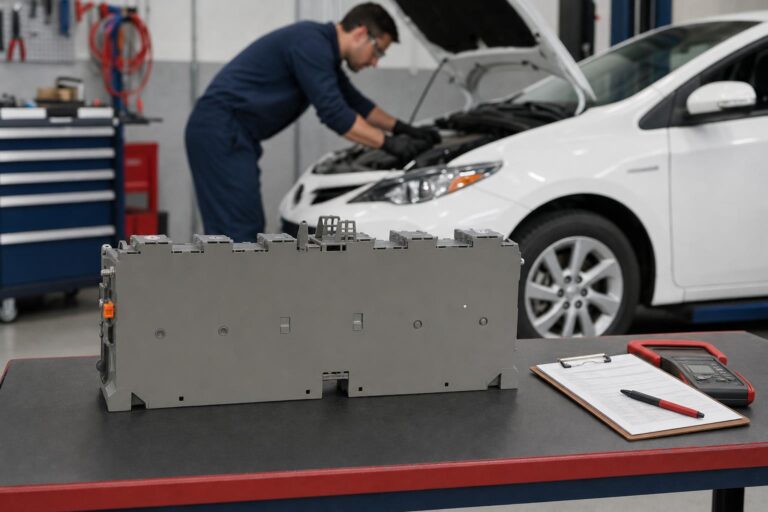
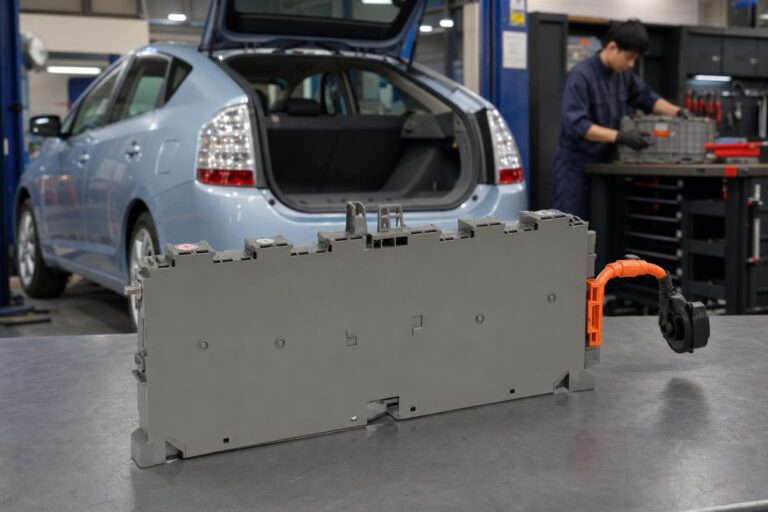
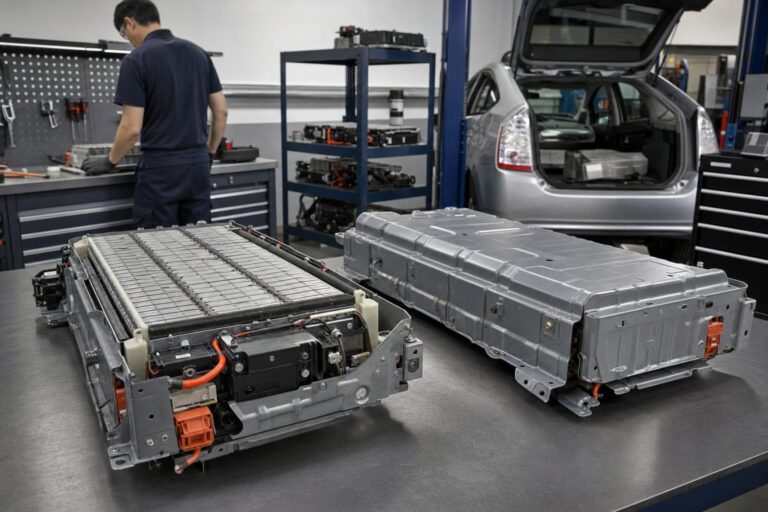
Pålitelige hybridbatteriløsninger



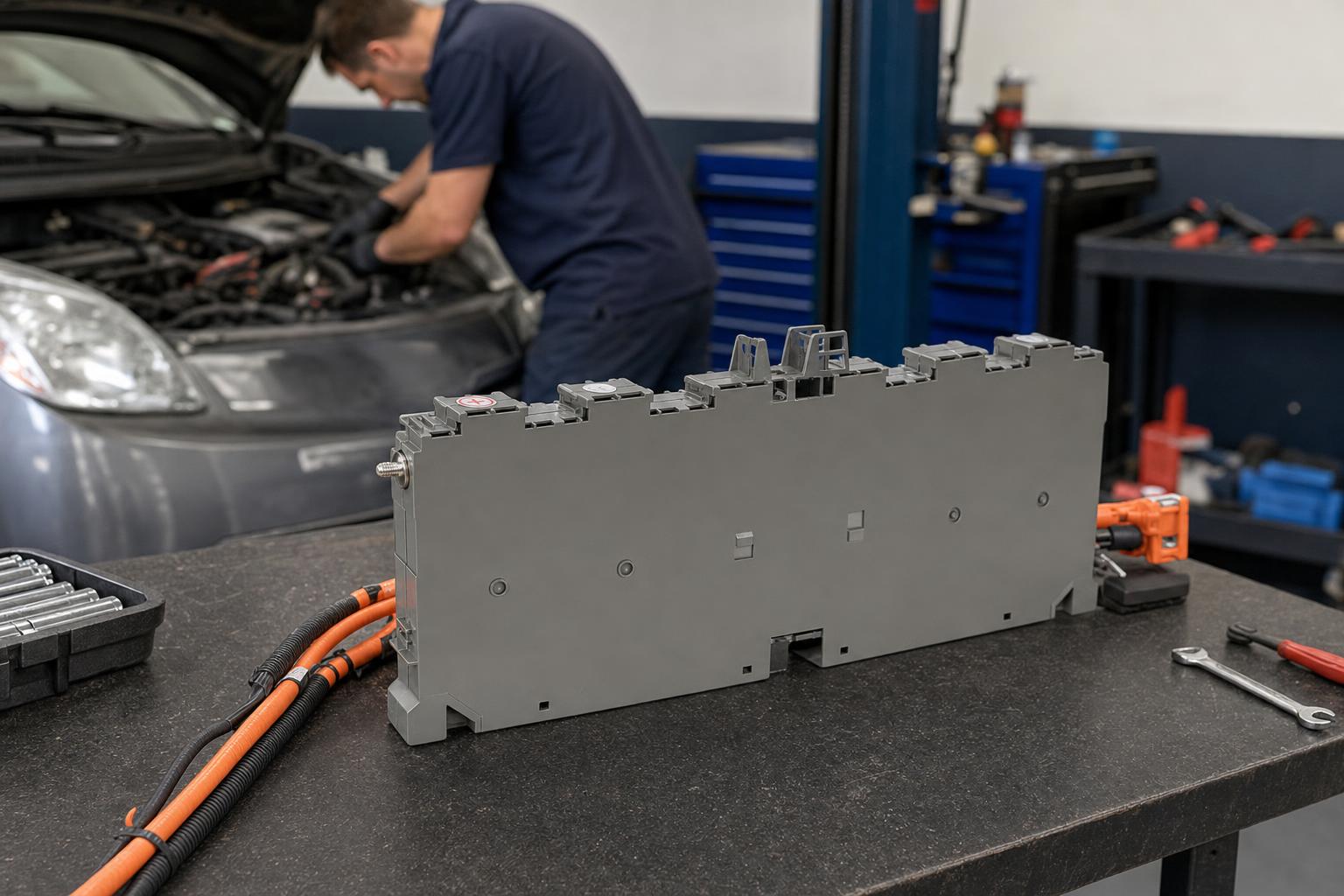
Batteribytte i 2006 Prius: NiMH-montering av 2. generasjon, kostnadsnivåer og innkjøp i 2026
A buyer-focused guide to 2006 Prius hybrid battery replacement: how to identify the Gen 2 NiMH pack, read 2026 cost tiers, and weigh a brand-new OEM-spec pack against rebuilt and used options.

EN 2006 Prius battery replacement means swapping the second-generation (Gen 2 / NHW20) nickel-metal-hydride (NiMH) traction pack that powers the hybrid system. In 2026, published US-market cost estimates for this model year span a wide range: independent estimators put a dealer-level installed job at roughly $3,655–$3,775, while remanufactured and used packs are quoted far lower. For a car that is now around 20 years old, the real decision for owners, repair shops and fleet buyers is not just price — it is which pack condition gives the most dependable service life for the money.
This guide explains which battery a 2006 Toyota Prius uses, the warning signs of failure, the 2026 cost tiers, and why a brand-new OEM-spec NiMH pack is worth considering against rebuilt or used alternatives when you are supplying or servicing aging Gen 2 cars.
Viktige konklusjoner
- The 2006 Prius (Gen 2 / NHW20) uses a ~1.3 kWh NiMH traction pack of roughly 201.6 V nominal, built from 28 prismatic modules.
- 2026 published US-market costs span a wide band: independent estimators list a dealer-level installed replacement near $3,655–$3,775, while used/salvage packs appear as low as $600–$1,200.
- Rebuilt and used packs mix aged cells, so their real-world lifespan and warranty exposure can be unpredictable on a 20-year-old car.
- A brand-new OEM-spec NiMH pack uses all-new, matched cells, which reduces the module-imbalance risk seen in reconditioned or salvage units.
- Cross-border B2B buyers should plan for UN 3496 hazardous-goods handling, labor time, and old-pack disposal when sourcing replacements.
Which battery does a 2006 Prius use?
The 2006 Toyota Prius belongs to the second-generation Prius (chassis code NHW20), produced from 2004 through 2009. Its high-voltage traction battery is a nikkelmetallhydrid (NiMH) pack with an energy capacity of about 1.3 kWh. The pack is assembled from 28 sealed prismatic modules, each nominally 7.2 V, giving a full-pack nominal voltage of roughly 201.6 V. This is the “HV battery” that drives the electric motor and is charged by regenerative braking and the engine-driven generator — not the small 12 V auxiliary battery that runs the computers and accessories.
Searches for an “06 Prius battery” or “2006 Prius hybrid battery replacement” almost always refer to this traction pack, because that is the component that triggers hybrid warning lights and drives the large repair quotes. When you specify a replacement, you are matching this Gen 2 NiMH architecture — voltage, module count and physical format — rather than a one-size-fits-all battery.
Gen 2 is not interchangeable with other generations
A common sourcing mistake is assuming all Prius packs are the same. The first-generation (NHW11), third-generation (ZVW30) and later lithium variants differ in module design, voltage, bus-bar layout and ECU communication. A pack intended for a Gen 3 car will not correctly fit or integrate with a 2006 NHW20. Always confirm the generation by VIN and model year before ordering.
Signs the 2006 Prius hybrid battery needs replacing
NiMH traction packs degrade gradually, then fail noticeably. On a Gen 2 Prius the typical symptoms, in rough order of severity, are:
- Falling fuel economy: the engine runs more often to compensate for a weak pack, so MPG drops noticeably from the car’s normal figure.
- Erratic state-of-charge behavior: the dashboard battery gauge swings quickly between full and empty, or the engine starts and stops abnormally.
- Reduced electric assist and performance: sluggish acceleration, especially from a stop.
- Warning lights: the hybrid warning light, check-engine light, and the master warning triangle — widely known among owners as the “triangle of death.”
- Stored fault codes: a diagnostic scan often reveals a P0A80 (replace hybrid battery pack) or related module-imbalance codes.
For a workshop, the triangle warning plus a P0A80 code is the strongest confirmation that the traction pack — not a sensor, inverter or 12 V battery — is the root cause. Always confirm with a scan tool before quoting a replacement, because a weak 12 V battery can mimic some of these symptoms at far lower cost.
2026 cost comparison: new, reman and used NiMH packs
Replacement pricing for the 2006 Prius has settled into clear tiers in 2026, and the spread is large. Understanding what each tier actually buys is the core of this purchase decision.
Ifølge RepairPal’s estimator, last updated September 3, 2026, the average dealer-level Hybrid High Voltage Battery Replacement for a 2006 Prius runs about $3,655–$3,775, with labor around $256–$376 and parts near $3,399. That labor figure implies roughly two to three hours at typical US shop rates, not a sub-hour job. A June 2026 industry comparison from Skrapplassinventar breaks the Gen 2 packs down further: new OEM (dealer/genuine) around $2,700–$3,500, rebuilt around $1,200–$2,000, and used/salvage around $600–$1,200. An October 2026 guide from Supercar Digest notes that genuine new OEM packs for 2004–2009 Prius models are increasingly hard to find, pushing many owners toward remanufactured or used packs commonly priced $1,200–$2,500 installed.
| Pack condition | Typical 2026 third-party market range | What this tier includes |
|---|---|---|
| Dealer / genuine OEM installed | ~$3,000–$6,700 (incl. labor) | Full-service dealer replacement; highest price, dealer warranty. |
| New OEM (dealer/genuine) pack only | ~$2,700–$3,500 (pack) | Brand-new genuine OEM pack as reported by third-party estimators; not an OKACC price. |
| Remanufactured / rebuilt | ~$1,200–$2,600 installed | Reused casing with replaced or tested modules; mixed cell age. |
| Used / salvage | ~$600–$1,200 | Second-hand pack of unknown remaining life; shortest warranty. |
Footnote: The reman/rebuilt installed range merges Junkyard Inventory’s rebuilt pack figures (~$1,200–$2,000) with Supercar Digest and RecycleFind installed estimates (up to ~$2,600), so each underlying source range remains traceable. All figures are third-party market context, not OKACC pricing.
A 2026 cost tool from RecycleFind similarly reports reman/specialist installed totals of roughly $1,350–$2,600 for 2004–2009 Prius versus dealer/OEM totals of $3,000–$6,700, citing RepairPal’s September 2026 data. Use these figures to benchmark quotes, then evaluate longevity, not just the headline number.
Why new, matched cells reduce imbalance risk versus rebuilt and used packs
On a 20-year-old Gen 2 Prius, the cheapest pack is rarely the best value. The reason lies in how NiMH packs age and fail.
A NiMH traction pack is only as strong as its weakest module. Over two decades, cell chemistry degrades, internal resistance rises, and modules drift out of balance. Reprodusert og refurbished packs typically reuse the original casing and bus bars while replacing or re-testing individual modules — but they frequently combine modules of different ages and histories. Used/salvage packs are whole second-hand units pulled from donor cars, with no reset of the aging clock. In both cases, a single weak module can pull the whole pack back into fault, which is one reason warranties on these tiers are often short.
EN brand-new OEM-spec NiMH pack is built from all-new, matched cells assembled to meet the original pack’s electrical and physical specifications. Because every module starts life at the same point, the balance problems associated with mixed-age cells are avoided from the outset. For repair shops and fleet buyers who want to fit a battery once and reduce the chance of a warranty return, that consistency is the core argument for a new pack over a bargain rebuilt or salvage unit. OKACC positions its traction packs as New NiMH Hybrid Battery Replacement, designed to meet OEM specifications — never refurbished, reconditioned, used or remanufactured. You can review the full hybridbatteri-produktserie to compare formats.
What “New OEM-spec NiMH” means — and what it does not claim
Clear language matters in procurement, so here is exactly what the positioning means. A Nytt OEM-spesifikt NiMH hybridbatteriutskifting is a brand-new pack engineered to match the fit, voltage, module count and performance envelope defined by the original equipment specification for the application. “OEM-spec” describes the engineering target — matching the original specification — not the brand on the label. OKACC pricing for these packs is quote-based rather than a fixed published figure, and is separate from the third-party market ranges cited above.
It does ikke mean the pack is a genuine Toyota part, a factory-original Toyota component, or that the supplier is Toyota-affiliated or Toyota-approved. OKACC is an independent manufacturer. When you communicate options to end customers, keep that distinction explicit: a new OEM-spec pack is a new aftermarket battery built to the original specification, offered as an alternative to a dealer-supplied genuine part. OKACC’s manufacturing and inspection approach is described on its OKACC kvalitetssikring side.
Installation and sourcing considerations for B2B buyers outside China
Beyond the pack price, several practical factors shape the total landed cost and the job itself for distributors, importers and workshops.
Labor and installation
Independent US estimators put labor for a Gen 2 Prius HV battery swap at roughly two to three hours of book time, based on RepairPal’s $256–$376 labor estimate; real-world time varies with corrosion, access and whether the pack is tested after fitting. High-voltage work must only be performed by trained technicians using correct insulated tools and service-plug lockout procedures — this is not a safe DIY job, and we do not provide step-by-step high-voltage instructions here.
Shipping and compliance
NiMH traction packs can be regulated as dangerous goods depending on the transport mode, and are most commonly handled under the FN 3496 entry (batteries, nickel-metal-hydride) for sea freight under the IMDG Code, while some road and air movements may be exempt or subject to different conditions. Confirm the exact classification for your mode of transport, and build dangerous-goods documentation, packaging and freight into your lead-time and cost planning before committing to volume orders. Verify your logistics partner can handle the applicable classification.
Core charges and disposal
Many suppliers apply a core charge that is refunded when the old pack is returned, and some markets require certified recycling of the spent NiMH battery. Factor return logistics and local disposal obligations into your quote so the customer sees the full picture. To confirm available formats and lead times for a specific program, be om et teknisk tilbud with your VIN or model-year volumes.
Related searches: 06 Prius battery and the 2006 Honda hybrid difference
Queries such as “2006 Prius hybrid battery replacement” and “06 Prius battery” all point to the same Gen 2 NiMH traction pack covered above. A buyer who starts with the short query is usually at the same decision point: confirm the car needs a pack, then compare new, reman and used options.
De 2006 Honda hybrid uses a different system. Mid-2000s Honda hybrids — the Civic Hybrid and Insight — use Honda’s Integrated Motor Assist (IMA) system, which pairs a smaller NiMH pack with a single thin electric motor between the engine and transmission. Compared with the Toyota Hybrid System in the Prius, an IMA pack has a different module layout, mounting and control strategy, so Honda and Toyota packs are not cross-compatible. If your inventory spans both brands, treat them as separate fitment lines: match the Prius pack to the NHW20 Gen 2 spec, and the Honda IMA pack to its specific chassis and model year.
Ofte stilte spørsmål
How much does a 2006 Prius battery replacement cost in 2026?
Published 2026 US-market estimates vary widely by pack condition. Independent estimators list a dealer-level installed job around $3,655–$3,775, new OEM packs around $2,700–$3,500, rebuilt packs around $1,200–$2,600 installed, and used/salvage packs around $600–$1,200. These are third-party market figures, not OKACC pricing.
What type of battery is in a 2006 Toyota Prius?
It is a nickel-metal-hydride (NiMH) high-voltage traction pack of about 1.3 kWh, roughly 201.6 V nominal, built from 28 prismatic modules. This is the second-generation NHW20 architecture used in 2004–2009 Prius models.
Is it worth replacing the hybrid battery on a 20-year-old Prius?
Often yes, if the rest of the car is sound. A Gen 2 Prius with a healthy engine and transmission can run reliably for years on a fresh pack. The key is choosing a pack whose expected life justifies the labor and downtime — which is why many longevity-focused buyers favor a brand-new pack over a short-warranty rebuilt or used unit.
Why is a new pack better than a rebuilt or used one?
A NiMH pack fails at its weakest module. Rebuilt and used packs mix modules of different ages, so one tired cell can pull the pack back into fault quickly. A brand-new OEM-spec pack uses all-new, matched cells, which reduces that imbalance risk from the start.
Does an OKACC pack mean a genuine Toyota battery?
No. OKACC supplies new aftermarket NiMH packs designed to meet OEM specifications. They are not genuine Toyota parts, and OKACC is not Toyota-affiliated or Toyota-approved. The pack matches the original specification; the brand is independent.
Can a 2006 Honda hybrid battery be used in a Prius?
No. The 2006 Honda Civic Hybrid and Insight use Honda’s IMA system with a different pack layout, mounting and control strategy. Honda IMA packs and Toyota Prius packs are not interchangeable and must be sourced as separate fitment lines.
What should I plan for when importing packs across borders?
NiMH traction packs can ship as dangerous goods depending on the transport mode, most commonly under UN 3496 for sea freight, so budget for compliant packaging, documentation and freight lead time. Also account for any core charge and local recycling obligations for the old pack.
If you are comparing replacement programs for a batch of 2004–2009 Prius vehicles or want to confirm available formats, you can kontakt OKACC Technical Sales with your model-year and volume details for a tailored response.