Zaufane rozwiązania hybrydowych akumulatorów































Wymiana akumulatora w Hondzie Insight: porównanie akumulatorów NiMH i Li-ion firmy IMA oraz rzeczywiste koszty
Referencje zakupowe B2B dotyczące wymiany akumulatora w hybrydowym pojeździe Honda Insight: montaż w poszczególnych generacjach, oznaki awarii, porównanie kosztów z cenami innych firm oraz porównanie nowych akumulatorów NiMH zgodnych ze specyfikacją OEM z opcjami regenerowanymi.

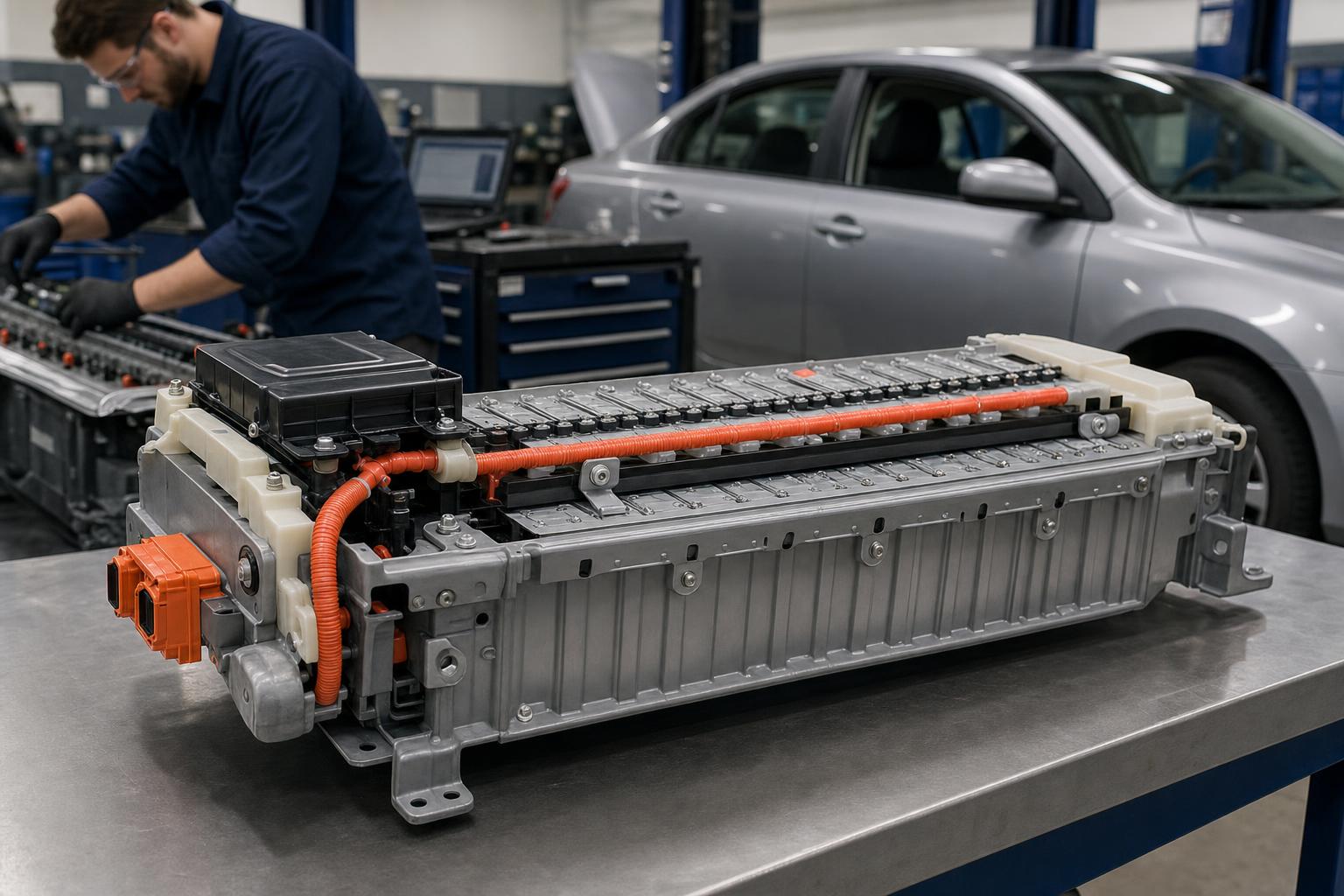
A Wymiana akumulatora w Hondzie Insight means swapping the vehicle’s high-voltage traction battery — the Integrated Motor Assist (IMA) pack on 2000–2006 and 2010–2014 cars, or the lithium-ion HEV pack on 2019–2022 cars — once the original pack loses usable capacity or throws a persistent hybrid fault. For repair shops, distributors and fleet operators sourcing outside China, the key decisions are matching the correct pack to the model year, understanding realistic third-party cost bands, and choosing between a brand-new OEM-spec pack, a remanufactured unit, or a reconditioned one. This guide walks through fitment by generation, failure signs, published cost benchmarks and how a new OEM-spec NiMH replacement fits a B2B procurement plan.
Najważniejsze wnioski
- The 1st-gen (2000–2006) and 2nd-gen (2010–2014) Honda Insight use NiMH IMA packs; the 3rd-gen (2019–2022) uses a lithium-ion HEV pack — the two chemistries are not interchangeable.
- Third-party estimators place Insight high-voltage battery replacement roughly between $2,500 and $5,600 depending on model year, with new OEM parts at the top and remanufactured packs in the middle.
- A brand-new OEM-spec NiMH pack removes the ageing-cell risk that comes with reconditioned or remanufactured units built from harvested modules.
- For B2B buyers, fitment verification, core-exchange terms and warranty clarity matter more than headline unit price.
Honda Insight hybrid battery landscape by generation
The Honda Insight has used three distinct high-voltage architectures across its production life, and confusing them is the most common sourcing error B2B buyers make.
1st generation (2000–2006): NiMH IMA
The original two-seat Insight introduced Honda’s Integrated Motor Assist system with a nickel-metal-hydride (NiMH) pack. More than two decades have passed since this generation launched, so most surviving units on the road have already had at least one battery event. Demand here is small but steady, driven by enthusiast owners and specialist workshops keeping early hybrids alive.
2nd generation (2010–2014): NiMH IMA
The five-door 2010–2014 Insight is the volume platform behind most 2010 Honda Insight battery replacement searches. It uses a NiMH IMA pack packaged behind the rear seat. This generation drives the bulk of aftermarket replacement demand because the cars are common, still economical to run, and reach the age where original packs commonly reach end of life. For most distributors, the 2010 Honda Insight battery is the highest-volume line in this family.
3rd generation (2019–2022): lithium-ion HEV
The most recent Insight moved to a lithium-ion pack under Honda’s newer two-motor hybrid system. It is a different chemistry, a different form factor and a different service procedure. A NiMH pack cannot substitute for it, and a NiMH supplier catalog will not cover it. Buyers should always confirm chemistry before quoting.
Because OKACC’s NiMH replacement range targets the IMA NiMH platforms, our model coverage for this vehicle is centred on the NiMH generations shown in the OKACC WGLĄD category. Always verify the specific model year against the catalog before committing an order.
Warning signs and diagnostic codes that point to IMA battery failure
A hybrid pack rarely fails without warning. On the NiMH Insight, the following symptoms are the field indicators a workshop should log before quoting a replacement:
- IMA and check-engine warning lamps illuminated together, often with the battery-level display dropping erratically.
- Rapid state-of-charge swings — the gauge climbing to full and dropping to near-empty within a short drive, a classic sign of cell imbalance.
- Reduced assist and regeneration, so the petrol engine works harder and fuel economy falls noticeably.
- Diagnostic trouble codes in the P0A7F, P0A80 and related IMA-battery family, indicating deterioration or a module fault reported by the battery control module.
- Recalibration loops where the system repeatedly charges and discharges the pack without stabilising.
These are indicators, not a substitute for a proper high-voltage diagnostic. High-voltage work must only be carried out by trained technicians using correct isolation procedures. Never advise or attempt live-pack DIY handling.
What Honda Insight battery replacement really costs: third-party benchmarks
Published third-party estimates vary widely because they mix model years, chemistries, part sources and labour rates. These are undated estimator and aggregator figures subject to change — use them as directional benchmarks, not fixed quotes.
- RepairPal’s estimator lists an overall Honda Insight high-voltage battery replacement average of roughly $4,089–$4,278, with 2010–2014 model years around $2,593–$2,747 and 2019–2022 model years around $5,343–$5,571.
- Najwyższa prędkość reports Honda’s parts catalog listing a new HEV battery module near $4,690.75 before tax and discounts, with some dealer scenarios near $2,000 and independent-workshop parts-only prices for older Insight packs around $1,800–$2,200 excluding labour.
- Cost Insider splits the market into a new-OEM band of roughly $2,300–$3,600 and a rebuilt/remanufactured band of roughly $1,200–$2,400, with labour typically $450–$1,500.
The pattern across these sources is consistent: new OEM parts sit at the top of the range, remanufactured or rebuilt packs occupy the middle, and labour is a substantial and variable line item. For B2B buyers pricing jobs at volume, the parts-only benchmark matters most, and that is where a brand-new OEM-spec pack sourced directly changes the margin equation.
Cost driver summary
| Cost driver | Effect on quote | What buyers should confirm |
|---|---|---|
| Model year / chemistry | 2019–2022 Li-ion packs cost markedly more than 2010–2014 NiMH | Chemistry and generation before quoting |
| Part source | New OEM highest, remanufactured mid, reconditioned lowest and most variable | Whether cells are new or harvested |
| Labour | Adds roughly $450–$1,500 depending on region and shop rate | Local labour rate and diagnostic time |
| Core exchange | May reduce headline part price but adds return logistics | Core-charge amount and return terms |
New OEM-spec vs remanufactured and reconditioned packs
Understanding the three market categories is essential for anyone reselling or installing Insight batteries.
Reconditioned / rebuilt
A reconditioned pack reuses the original modules, discharging, balancing and sometimes swapping the weakest cells. It is the cheapest option but carries the highest variance: the remaining cells are still aged, and mixed-age modules can drift back into imbalance. For fleet or resale use, this variability is a warranty liability.
Remanufactured
A remanufactured pack typically replaces more modules and rebuilds around a mix of new and tested-used cells. It usually outperforms a simple recondition but still combines components of differing ages and cycle histories.
Brand-new OEM-spec
A brand-new OEM-spec NiMH pack is built entirely from new cells manufactured to match the original pack’s electrical and mechanical specifications. Modules are drawn from closely matched production batches with identical cycle history, which is the single most important factor in long-term balance stability. This is the category OKACC supplies for the NiMH IMA Insight platforms — described only as a new NiMH hybrid battery replacement designed to meet OEM specifications, never as refurbished, reconditioned or remanufactured.
Why brand-new OEM-spec NiMH matters for long-term reliability
NiMH pack life is governed by cell balance. When all cells begin life together, they age together and the battery management system can keep them within a tight window. When a pack contains modules of different ages — as reconditioned and many remanufactured packs do — the weakest cells define the whole pack’s behaviour, and imbalance tends to return sooner.
For B2B buyers this translates directly into fewer comebacks, cleaner warranty claims and a more predictable service life across a batch of installs. Battery durability is also becoming a longer-term planning consideration: a 2026 hybrid-battery cost guide discusses CARB durability requirements in North American markets that set minimum capacity-retention thresholds over extended mileage for newer model-year vehicles, which is shaping how shops evaluate new-versus-remanufactured warranty coverage. Sourcing new cells from the start is the most defensible position for a shop or distributor standing behind the work. OKACC documents its manufacturing controls on the Zapewnienie jakości OKACC strona.
OKACC new OEM-spec NiMH hybrid battery for the Honda Insight
OKACC produces brand-new NiMH hybrid battery packs designed to meet OEM specifications for the NiMH IMA Honda Insight platforms. The positioning for B2B buyers is straightforward:
- Brand-new cells only — no harvested or mixed-age modules, giving a uniform starting condition across a pack.
- OEM-spec design intent — dimensioned and configured to fit the factory pack location and connect to the original IMA control system.
- Batch consistency for volume buyers — useful for distributors and fleets who need repeatable behaviour across multiple installs.
OKACC is an independent manufacturer of new OEM-spec replacement packs and is not Honda, genuine Honda or Honda-affiliated. Fitment for any specific model year should always be confirmed against OKACC’s own catalog. You can review the wider gama produktów akumulatorów hybrydowych to see adjacent Honda and Toyota coverage when planning a mixed stock order.
Installation, core exchange and warranty considerations
Even with the right pack in hand, a few operational details decide whether a job goes smoothly:
- Safe isolation. The IMA pack is a high-voltage system. Only trained technicians using correct personal protective equipment and isolation steps should handle it. This article does not provide live-pack handling instructions.
- Post-fit calibration. After installation, the system generally needs a period of controlled charge/discharge cycling to establish a stable state-of-charge reading. Plan for this in your service time.
- Obsługa rdzenia. If your supply arrangement involves a core, clarify whether a core is required, the core-charge value, and the return timeframe before you quote the customer.
- Warranty documentation. Keep the diagnostic record, install date and pack identifier so any warranty claim is clean. Confirm warranty terms with your supplier in writing rather than assuming an industry-standard period.
Bulk sourcing and international B2B ordering
For distributors, importers and fleet buyers, the sourcing conversation goes beyond a single pack:
- Consolidate by chemistry. Order NiMH IMA packs for 2000–2006 and 2010–2014 cars separately from any lithium-ion requirement, and confirm each line against the model year.
- Plan hazardous-goods logistics. Traction batteries are regulated for transport. Build compliant packaging, documentation and freight arrangements into lead-time expectations from the outset.
- Standardise on new cells for resale programmes. A consistent brand-new OEM-spec supply reduces the warranty tail on a batch and simplifies your customer messaging.
- Request a technical scope up front. Confirm fitment, connector configuration and packaging with your supplier before placing volume orders.
To align a specific model-year requirement with available packs and volume terms, poproś o wycenę techniczną with your vehicle years and quantities.
For a broader conversation about mixed stock planning across Honda and Toyota NiMH platforms, skontaktuj się z OKACC directly.
Często zadawane pytania
What type of battery does a 2010 Honda Insight use?
The 2010–2014 Honda Insight uses a nickel-metal-hydride (NiMH) Integrated Motor Assist pack located behind the rear seat. It is a different chemistry from the lithium-ion pack in the 2019–2022 Insight.
How much does Honda Insight battery replacement cost?
Third-party estimators place it roughly between $2,500 and $5,600 depending on model year and part source. RepairPal lists 2010–2014 cars near $2,593–$2,747 and 2019–2022 cars near $5,343–$5,571, with new OEM parts at the top of the range and labour typically $450–$1,500.
Is a new OEM-spec pack better than a remanufactured one?
A brand-new OEM-spec NiMH pack uses only new cells from closely matched production batches, so the modules age together and stay balanced longer. Remanufactured and reconditioned packs combine components of differing ages, which raises the risk of imbalance returning and complicates warranty support.
Can I fit a NiMH pack to a 2019–2022 Insight?
No. The 2019–2022 Insight uses a lithium-ion HEV battery, which is a different chemistry, form factor and control system. NiMH IMA packs are only for the 2000–2006 and 2010–2014 generations. Always confirm chemistry before ordering.
What warning signs indicate the IMA battery is failing?
Common signs include the IMA and check-engine lamps illuminating together, the charge gauge swinging rapidly between full and empty, reduced assist and regeneration, falling fuel economy, and IMA-battery diagnostic codes such as those in the P0A7F/P0A80 family.
Is OKACC a Honda part?
No. OKACC is an independent manufacturer of brand-new NiMH hybrid battery packs designed to meet OEM specifications, and it publishes its manufacturing and quality-control approach for buyer review. OKACC is not Honda, genuine Honda or Honda-affiliated. Fitment for a specific model year should be confirmed against OKACC’s own catalog.
What should distributors confirm before a bulk order?
Confirm chemistry and generation for each line, fitment and connector configuration against the supplier catalog, core-exchange terms if any, hazardous-goods transport arrangements, and written warranty terms before committing to volume.