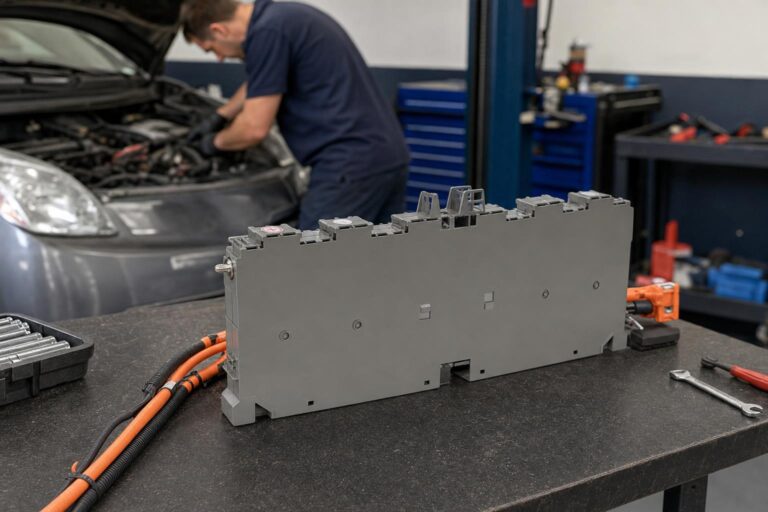
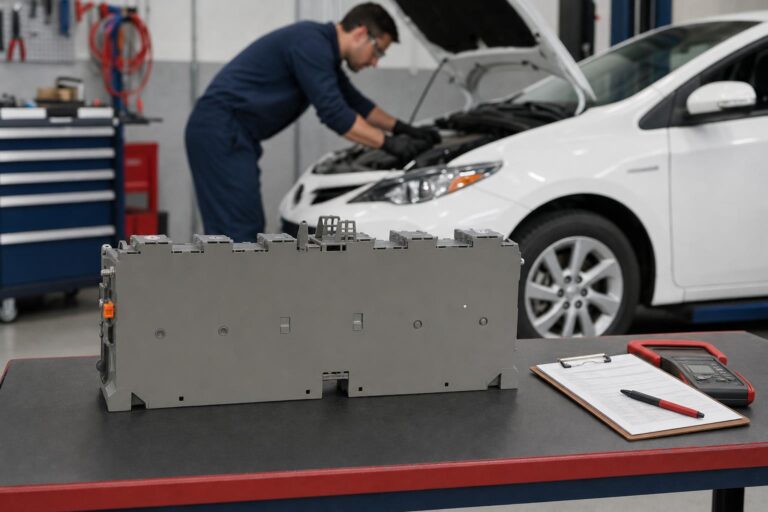
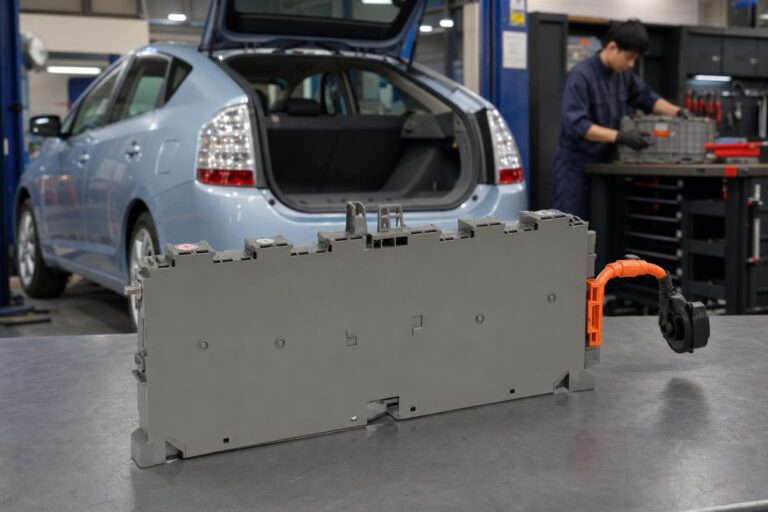
Pålidelige hybridbatteriløsninger



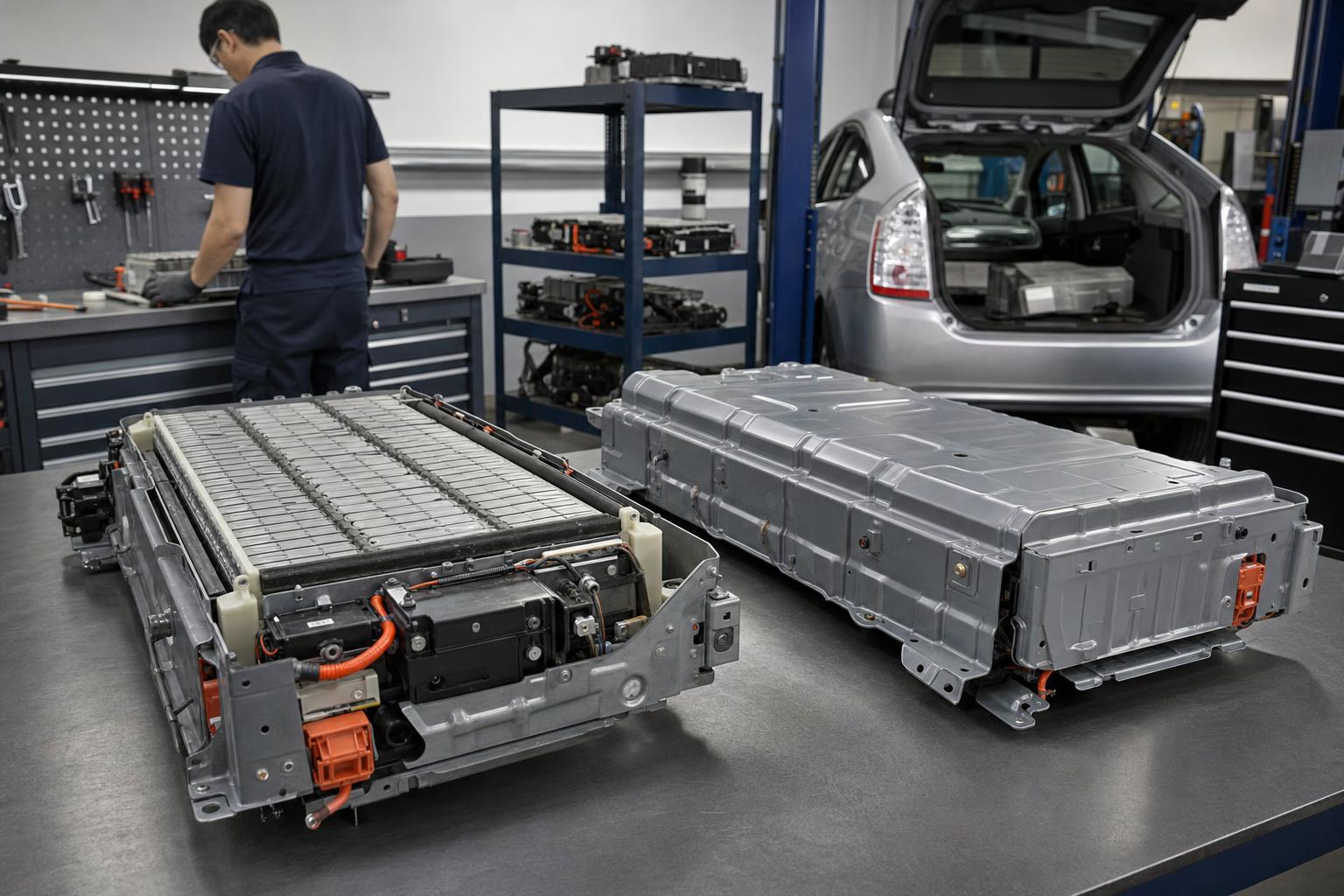
Istandsat vs. nyt Prius-batteri: Hvad hvert niveau virkelig køber
En sammenligning i beslutningsfasen af istandsatte, renoverede, genopbyggede og nye Prius-hybridbatterier med originaludstyr — med fokus på samlede ejeromkostninger, kapacitetsoplysning, garantidækning og leverandørgodkendelse for værksteder, flåder og distributører.

If you are choosing between a reconditioned Prius battery and a new replacement pack, the short answer is this: reconditioned and rebuilt packs win on upfront price but carry shorter warranties, lower starting capacity and wider quality-control variability, while a new OEM-spec NiMH pack costs more initially but usually delivers the lowest total cost of ownership on vehicles kept in long-term service. The right choice depends less on the headline price and more on the vehicle’s age, mileage and how long it will stay in the fleet or on the lot.
This guide is written for international B2B buyers outside China — independent repair shops, hybrid specialist workshops, fleet maintenance managers and parts distributors — who already know they need a Prius hybrid battery solution and are comparing options on cost, longevity, warranty and risk. It avoids DIY high-voltage instructions and focuses on the sourcing and quality-assurance decisions that protect your margin and your reputation.
Vigtige konklusioner
- “Reconditioned,” “refurbished” and “rebuilt” are used inconsistently across the market, so always ask exactly what was replaced, tested and warranted rather than relying on the label.
- Rebuilt and remanufactured packs typically start near 80% of original design capacity because used modules do not fully recover to new condition, while a new pack starts at 100%.
- Warranty length is the clearest proxy for underlying quality control: longer terms signal more rigorous testing and module matching.
- Reconditioned packs suit short ownership horizons and resale-bound vehicles; new OEM-spec NiMH packs usually reduce total cost of ownership for fleets and long-term-service cars.
- Request documented module-level test data, capacity figures and cooling-system service records before buying from any supplier.
Why the terminology matters before you compare prices
The biggest trap in this market is language. A pack sold as “reconditioned” by one supplier may be functionally identical to a “refurbished” or “rebuilt” pack from another — or materially different. Because there is no universal standard behind these words, two quotes that look comparable on price can represent very different levels of testing, module sourcing and risk.
For a B2B buyer, that inconsistency is a procurement problem, not a semantic one. If you resell or fit the wrong tier, you absorb the warranty claims, the repeat labour and the customer complaints. Before comparing any numbers, pin down what the supplier actually did to the pack and what they will stand behind in writing.
The four paths: defining each Prius battery option
Most of the market resolves into four practical categories, each with a distinct cost, capacity and warranty profile.
Reconditioned (in-pack module swap and rebalance)
Reconditioning typically keeps the original pack casing and bus bars, tests every module, replaces the weakest modules with matched healthy used ones, cleans electrical connections, rebalances the pack and services the cooling fan and intake. As hybrid specialists note, heat is the primary driver of battery aging, so cooling-system service is a core part of a credible reconditioning job. This is usually the lowest-cost, shortest-lived option.
Refurbished / remanufactured packs
A refurbished or remanufactured pack is generally built from tested and matched used modules, often assembled off the vehicle and supplied as a complete unit on an exchange basis. Quality depends heavily on how tightly the modules are matched for capacity and internal resistance.
Rebuilt packs and rebuild kits
Rebuilt packs — including the rebuild kits marketed to workshops — are assembled from used modules, either by a specialist or in-house. The outcome is only as good as the module screening behind it, and kit-based builds carry the widest variability in performance and safety. Remember that hybrid pack removal, testing and assembly involve lethal high-voltage hazards and should only be performed by trained technicians with appropriate HV insulation and personal protective equipment.
New OEM-spec NiMH replacement packs
A new pack uses new cells and starts at full design capacity. New OEM-spec options from independent manufacturers are typically positioned below dealer pricing while carrying longer warranties than reconditioned or rebuilt alternatives. OKACC supplies New OEM-spec NiMH Hybrid Battery Replacement packs designed to meet OEM specifications — never reconditioned, refurbished or remanufactured units — which is the relevant comparison point for the “new” column below.
One fitment caution applies across all four paths: while most Prius generations use NiMH packs, some later generations and trims use lithium-ion chemistry instead, so always verify pack chemistry and exact fitment by model year and VIN before ordering.
Cost-benefit breakdown: what drives each price band
Independent repair-industry pricing guides describe a tiered Prius battery market, from genuine dealer-fitted new packs at the top to reconditioned-in-place packs as the lowest-cost, shortest-lived option. The structure of that tiered market places independent new-cell packs with multi-year warranties between the dealer and remanufactured tiers.
The main cost drivers across every tier are labour, any core charge on the old pack, module sourcing and the depth of testing. A cheap quote often signals thinner testing or fewer replaced modules — which is exactly where downstream failure risk lives. Treat large price gaps as a prompt to ask what was skipped, not as a straightforward saving.
| Valgmulighed | Typical starting capacity | Relative upfront cost | Warranty profile | Best-fit scenario |
|---|---|---|---|---|
| Reconditioned (in-pack) | Lowest of the four | Lowest | Shortest (often workshop-backed, commonly 12–24 months per third-party market sources) | Older, resale-bound or short-horizon vehicles |
| Refurbished / remanufactured | ~80% of original design (per market context) | Low–moderate | Commonly 12–24 months (per third-party market sources) | Budget-focused buyers accepting capacity trade-offs |
| Rebuilt / rebuild kit | Variable, depends on module screening | Low | Often limited or none on kit-based builds | Specialist shops with in-house testing capability |
| Nyt OEM-specifik NiMH | 100% of design capacity | Highest after dealer | Longest among non-dealer options | Fleets and long-term-service vehicles |
Figures reflect general market context from third-party sources and are not OKACC offers, specifications or guarantees.
Capacity and longevity: the number buyers forget to ask about
Starting capacity is where the reconditioned-versus-new gap becomes concrete. A rebuilt or remanufactured hybrid battery pack typically starts at roughly 80% of original design capacity, compared with 100% for a new pack, because even healthy used modules do not fully return to new-condition capacity after testing and balancing.
That matters more over time than it does on day one. As a NiMH pack ages, the usable state-of-charge window narrows. A pack that begins at 80% has less headroom before the hybrid system starts throwing codes, so the practical service life before the next intervention is shorter. For a vehicle you plan to sell within a year, that trade-off can be acceptable. For a fleet car expected to run several more years, it often means paying twice.
Warranty and risk: reading the terms as a quality signal
Warranty length is the single most useful proxy a B2B buyer has for underlying quality control. A supplier willing to back a pack for three to four years is making a very different statement about their module matching and testing than one offering 90 days. The warranty is where the supplier’s own confidence becomes a contractual promise.
When comparing terms, read past the headline number. Check whether the warranty is pro-rated, whether it covers labour and diagnostics or parts only, how core returns and shipping are handled across borders, and what the claim process looks like from another country. A long warranty that is impractical to claim on internationally is worth less than a shorter one with a clear process.
Quality-assurance checklist for B2B buyers
Whatever tier you choose, insist on documentation. The following items separate a defensible purchase from a gamble:
- Module-level test data: capacity and internal-resistance figures for each module, not just a single pack-level reading.
- Voltage-balance verification: evidence the pack was balanced after assembly, with before/after values where possible.
- Capacity disclosure: a stated starting capacity figure, so you can compare like with like across suppliers.
- Cooling-system service record: confirmation the fan and intake were cleaned or serviced, given heat’s central role in NiMH aging.
- Traceable warranty terms: written coverage, duration, exclusions and a cross-border claim process.
- Manufacturing and QC transparency: for new packs, documented production and inspection processes. You can review how one manufacturer frames this on a dedicated page such as OKACC kvalitetssikring.
If a supplier cannot or will not provide module-level data, treat the pack as untested regardless of the label on the box.
When each option makes commercial sense
There is no single right answer — only a right answer for a given vehicle and holding period.
Reconditioned or rebuilt packs fit best where upfront cost dominates the decision: older vehicles, cars being prepared for resale, or situations where the owner explicitly accepts a shorter workshop warranty. An Australian market guide positions reconditioned packs for vehicles six or more years old where the buyer prioritises minimising spend and accepts a typical 12-to-24-month warranty.
New OEM-spec NiMH packs make the strongest case for fleets and long-term-service vehicles. Full starting capacity, the longest non-dealer warranties and predictable behaviour over time usually translate into the lowest total cost of ownership when the vehicle will be kept for years. For a fleet manager, avoiding a second battery intervention and its associated downtime often outweighs the higher upfront figure.
Distributors and resellers should also consider their own exposure: reselling a short-warranty reconditioned pack to an end customer concentrates claim risk on your business. New packs with longer, clearly documented warranties shift that risk onto a defined supplier relationship.
Sourcing considerations for international buyers
Cross-border sourcing adds layers that domestic buyers rarely face. Vet suppliers on certification transparency, documented testing and a realistic international warranty process before price enters the conversation.
Be especially cautious with “OEM” and “genuine Toyota” claims. Unless a supplier can independently verify such a claim, treat it as marketing language. A credible independent manufacturer will describe its product accurately — for example, as a new OEM-spec NiMH replacement designed to meet OEM specifications — rather than implying a factory affiliation it cannot prove. You can review one manufacturer’s full hybridbatteri-produktsortiment as a reference point for how a new-pack supplier should present scope and specification.
Finally, confirm shipping compliance for hybrid batteries early, since NiMH packs may be regulated as dangerous goods depending on transport mode and jurisdiction, and documentation gaps cause expensive delays. When you have narrowed your shortlist, a structured enquiry — ideally one that lets you anmod om et teknisk tilbud with model and specification details — produces far more useful comparisons than a bare price request. If you need to clarify sourcing or compliance questions first, you can kontakt OKACC direkte.
A simple decision framework
Match the option to the vehicle, not the other way around:
- High-mileage, resale within 12 months: reconditioned or refurbished may be justified if the warranty and capacity are disclosed in writing.
- Daily-driver kept 2–4 more years: weigh a new OEM-spec pack’s longer warranty against the recurring risk of a short-life pack.
- Fleet or commercial-use vehicle: prioritise full starting capacity, the longest practical warranty and documented QC — typically a new pack.
- Reseller stock: favour options whose warranty you can honour internationally without absorbing undue claim risk.
The decision is rarely about which battery is “better” in the abstract. It is about which battery lowers your total cost and risk over the period you actually hold the vehicle.
Ofte stillede spørgsmål
What is the difference between a reconditioned and a refurbished Prius battery?
The terms are used inconsistently. Reconditioning usually means testing modules in the original pack and swapping the weakest for matched used ones, while refurbished or remanufactured often means a complete pack assembled from tested used modules. Because there is no universal standard, always ask exactly what was replaced, tested and warranted rather than relying on the label.
Why do rebuilt packs start at lower capacity than new ones?
Rebuilt and remanufactured packs are built from used modules that, even in good health, do not fully recover to new-condition capacity after testing and balancing. Market sources put typical starting capacity near 80% of original design, versus 100% for a new pack, which reduces usable headroom and shortens practical service life.
Is a reconditioned Prius battery ever the right B2B choice?
Yes — on older, resale-bound or short-horizon vehicles where minimising upfront cost matters most and the buyer accepts a shorter warranty. It is a weaker choice for fleets or long-term-service vehicles, where full capacity and a longer warranty usually deliver lower total cost of ownership.
How does warranty length indicate quality?
Warranty duration reflects the supplier’s own confidence in their testing and module matching. A pack backed for three to four years signals more rigorous quality control than one offering only a few months. Always check whether the warranty covers labour, how it handles core returns, and whether claims are practical to make across borders.
What documentation should I request before buying?
Ask for module-level capacity and internal-resistance data, voltage-balance verification, a stated starting capacity, cooling-system service records, and written warranty terms with a defined cross-border claim process. If a supplier cannot provide module-level data, treat the pack as effectively untested.
Should I trust a supplier claiming “genuine Toyota” or “OEM” packs?
Only if the claim is independently verifiable. Unverified “genuine Toyota” or “OEM” language is common marketing. A credible independent manufacturer will describe its product accurately — for instance, as a new NiMH replacement designed to meet OEM specifications — rather than implying a factory affiliation it cannot prove.
Third-party pricing, capacity and warranty figures referenced above are general market context from independent sources and do not represent OKACC offers, specifications, compatibility or guarantees. Verify all technical details for your specific vehicle and jurisdiction before purchasing.