Soluzioni affidabili per batterie ibride































Hybrid Car Battery Price in 2026: A B2B Guide to Cost Drivers and Comparing Replacement Packs
Hybrid battery replacement quotes ranged from roughly $1,000 to over $8,000 in 2026. Here is what drives the price, how OEM-new and new OEM-spec NiMH options compare to reconditioned packs, and how repair shops, distributors and fleets can judge real value before sourcing.

The short answer buyers want first: in 2026, a hybrid car battery price for a full high-voltage pack replacement ranges from roughly $1,000 for a basic reconditioned unit to more than $8,000 for a luxury dealer-installed OEM pack. Most mainstream hybrids land between $2,000 and $4,000 all-in, while one widely cited repair-cost estimator puts the average total replacement at around $5,053 to $5,253. The wide spread is not random — it reflects the type of pack you buy, the vehicle, the region, and how much labour and diagnostics are bundled into the quote.
This guide breaks down the hybrid battery price question for professional buyers: independent repair shops, hybrid-specialist workshops, parts distributors and fleet operators who need to compare sourcing options before they commit. We define the key terms, compare the main replacement categories, map costs by brand, and give you a checklist for judging value beyond the sticker. For clarity, OKACC is an independent supplier of brand-new NiMH hybrid battery replacements and is not affiliated with Toyota, its OEM dealer network, or the remanufactured and reconditioned battery market; the third-party price data cited below is used only to help buyers benchmark the wider market.
Punti chiave
- 2026 hybrid battery replacement pricing spans a very wide band — roughly $1,000 to $8,000+ — driven mainly by pack type, vehicle brand and labour rates.
- Parts dominate the total: dealer-grade packs alone often average around $4,600–$5,000, while labour typically adds $150–$640.
- Third-party 2026 data shows a large gap between dealer OEM-new packs and remanufactured units; the exact figures depend on the dataset and models sampled.
- A brand-new OEM-spec NiMH replacement targets new-battery reliability without the unknowns of used or reconditioned cells.
- Hidden costs — diagnostic fees, core/disposal charges and related cooling or relay repairs — can move a quote by hundreds of dollars.
Why hybrid battery prices vary so widely in 2026
Ask three suppliers for a hybrid battery price on the same car and you can easily receive three answers that differ by thousands of dollars. This is normal in the hybrid battery market because a single search phrase — whether it is worded as hybrid battery price, battery hybrid price, car hybrid battery price O HV battery price — covers several genuinely different products.
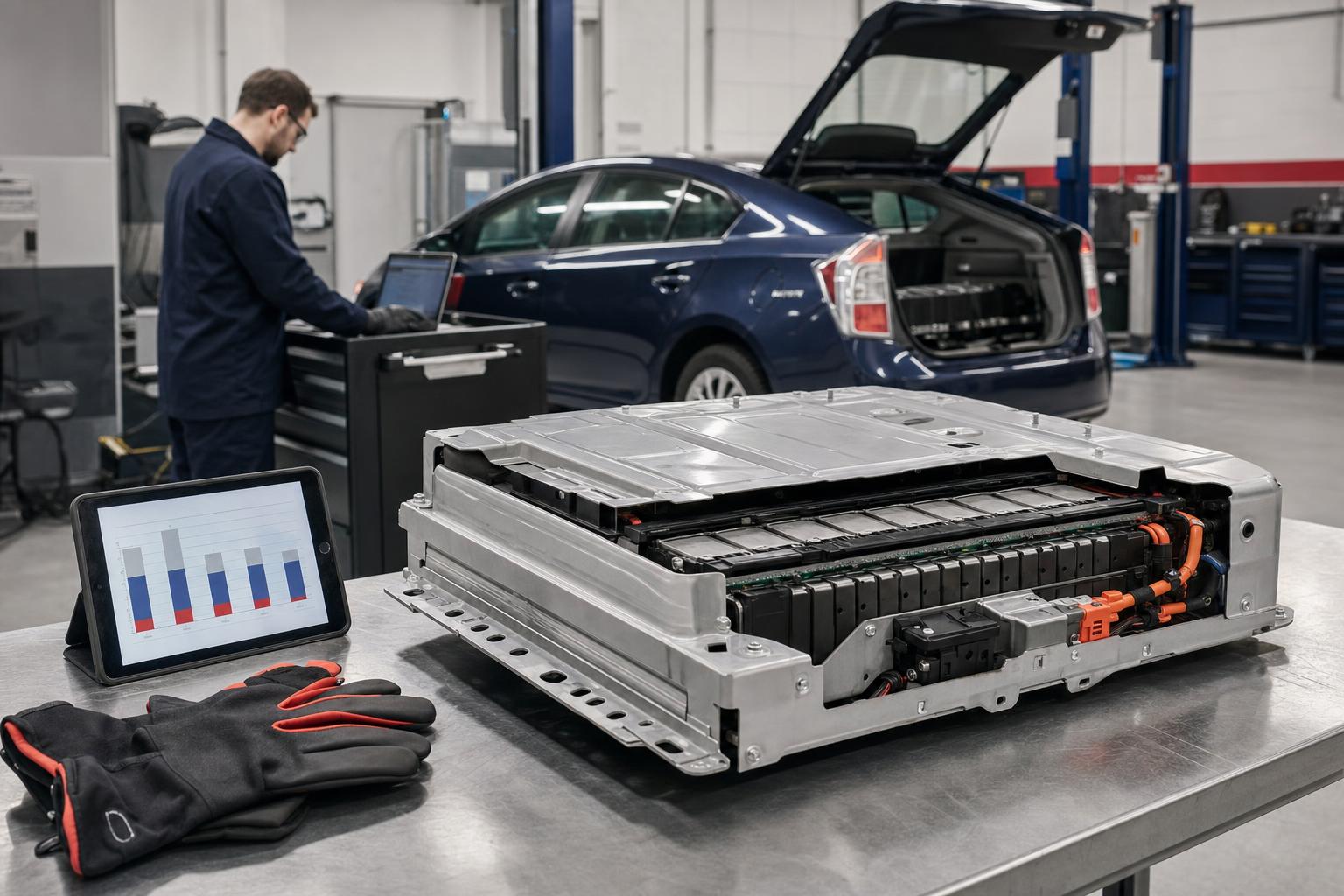
A hybrid high-voltage (HV) battery is the traction pack that powers the electric motor, distinct from the small 12V auxiliary battery. In most established hybrids it is built from idruro di nichel-metallo (NiMH) modules, though some newer and plug-in models use lithium-ion. The pack combines individual modules, a cooling system, wiring, sensors and a battery management/ECU layer. Because a quote can refer to just the cells, a full assembled pack, or a pack plus installation and diagnostics, the price you compare depends entirely on scope.
On top of scope, four external factors move the number: the vehicle brand and pack capacity, whether the seller is a dealer or independent, the local labour rate, and the condition of the battery being supplied (new, remanufactured or reconditioned). Understanding these lets you read a quote the way an experienced buyer does.
Safety note. A hybrid HV traction pack typically operates at 100–300V or more and can cause serious injury or death. Diagnosis, service-plug disconnection and pack replacement must be performed only by trained technicians using insulated tools and gloves and following the manufacturer’s high-voltage disconnect and lock-out procedures. This article is a sourcing and cost reference, not a DIY repair guide.
Average hybrid battery replacement cost: parts vs. labour
The clearest way to understand a hybrid car battery price is to separate parts from labour, because the two behave very differently.
Parti are the largest component. Repair-cost data in 2026 puts the pack itself at around $4,626 on a dealer-grade basis, and other estimators cite average parts costs of roughly $5,000 for dealer packs. This is where the biggest savings — or the biggest overspend — occurs.
Lavoro is comparatively modest and more predictable. Published 2026 figures cluster between roughly $427 and $626, with another source citing $440 to $640, and broader ranges of $150–$600 depending on the shop and vehicle. A straightforward pack swap on an accessible hybrid takes a few hours; a model that buries the pack under interior trim or requires extra system resets takes longer.
For buyers, the practical lesson is simple: because labour is a small and stable slice, the part you source is the single biggest lever on the final hybrid battery price. Choosing the right pack category is where procurement decisions are won or lost.
Cost comparison: OEM-new vs. remanufactured vs. new OEM-spec NiMH
Most 2026 replacement pricing falls into four categories. The table below summarises typical market ranges reported by independent cost trackers, with each figure labelled by its source dataset. These are third-party market figures for the broad category — not a quotation for any specific product, and averages from one study will not always sit inside a range drawn from another.
| Replacement option | Reported 2026 figure (pack) | Condition | Best-fit buyer scenario |
|---|---|---|---|
| Reconditioned / refurbished | $1,000–$1,800 market range (per Empire Auto Protect) | Used cells rebalanced | Lowest upfront cost, shortest expected life |
| Remanufactured (third-party) | $1,400–$2,500 market range (per Empire Auto Protect); ~$3,443 average (per 25-model study) | Mixed new/used components | Mid-tier budget, variable warranty |
| OEM-new (dealer) | $2,000–$4,500 market low-end (per Empire Auto Protect); ~$6,847 average (per 25-model study); luxury dealer packs exceed this range | Brand-new | Warranty-sensitive, cost secondary |
| New OEM-spec NiMH replacement | Quotation-based per application; positioned below full dealer OEM | Brand-new | New-battery reliability at a competitive price |
The category ranges above are drawn from a 2026 ripartizione dei costi and a 25-model study that reported OEM-new packs averaging $6,847 versus $3,443 for third-party remanufactured — a difference of about $3,400 per vehicle in that dataset. Because the range figures and the average figures come from different studies, they should be read as separate reference points, not as a single continuous scale. That roughly 50% gap between dealer OEM-new and remanufactured is the core tension every hybrid battery buyer is trying to resolve.
Reconditioned and remanufactured packs win on price but reuse cells of unknown history, which makes life expectancy and warranty terms inconsistent. Dealer OEM-new packs win on peace of mind but carry the highest cost. The category that a value-focused buyer often overlooks is a brand-new OEM-spec NiMH hybrid battery replacement — a new pack engineered to meet OEM specifications, giving new-battery condition without the pricing structure of the dealer network.
OKACC, as an independent supplier unaffiliated with Toyota or any OEM dealer network, offers brand-new NiMH hybrid battery replacements in exactly this category. Every unit in the Gamma di prodotti per batterie ibride is manufactured brand-new — never reconditioned, remanufactured or used — and designed to meet OEM specifications. OKACC pricing is quotation-based per application rather than a fixed market rate, so buyers should benchmark a specific OKACC quotation against the third-party ranges above rather than assume a set position; that per-application distinction is what professional buyers need when comparing a headline hybrid battery price against long-term reliability.
Cost by vehicle brand and model
Brand and pack size shift the hybrid car battery price significantly. The following are indicative 2026 market ranges reported by third-party sources, useful for benchmarking incoming quotes rather than as fixed prices. Before ordering for any specific vehicle, always verify pack part number, nominal voltage, module count and the connector and cooling configuration for that exact generation, as these differ across model years.
Toyota and Lexus
Toyota hybrids anchor the market. A Toyota hybrid car battery price for a Prius pack through a dealer typically runs $3,500 to $5,500 installed, and Toyota’s hybrid battery warranty coverage can reach 10 years or 150,000 miles in states following California emissions rules. Lexus models, sharing much of Toyota’s hybrid architecture but sold at a premium, generally sit at the higher end and are frequently where dealer totals climb past $5,000–$8,000.
Honda
Honda’s Integrated Motor Assist (IMA) hybrids — Civic Hybrid, Insight, CR-Z — use smaller NiMH packs, so replacement figures generally tend to sit in the lower mainstream band, though older discontinued models can raise sourcing complexity more than headline cost.
Ford, Hyundai, Kia and others
Ford’s earlier NiMH hybrids (such as the Fusion Hybrid) generally show notably wide quote spreads because the market mixes dealer, remanufactured and independent supply. Hyundai and Kia hybrids, being newer, generally more often use lithium-ion and are usually still inside factory coverage, which tends to shift the immediate cost conversation toward warranty rather than out-of-pocket replacement.
Across all brands the pattern holds: capacity and dealer positioning push the price up, while independent and OEM-spec new alternatives pull it down.
What actually drives the price
Beyond the pack category, five technical and market factors explain most of the variation in any hybrid battery price:
- Battery chemistry. NiMH packs dominate cost-sensitive replacement demand; lithium-ion packs, common in newer PHEVs, generally cost more to replace.
- Pack capacity and module count. A larger pack with more modules and higher voltage costs more in materials, full stop.
- Diagnostica. Confirming the pack is the real fault — not a cell imbalance, cooling fault or control-module issue — protects against replacing the wrong part.
- Labour rate. The same job costs materially more in a high-wage metro than in a lower-cost region.
- Supply channel and region. Dealer, independent and cross-border wholesale pricing differ sharply, and import logistics add cost for international buyers.
For distributors and shops buying in volume, controlling the part source and channel — rather than the labour — is where margin and competitiveness are built.
Hidden and additional costs to expect
A clean pack price rarely equals the final invoice. Build these into any comparison:
- Diagnostic fees. Often billed separately at roughly $50 to $180, sometimes credited against the repair if you proceed.
- Core and disposal charges. Many suppliers require the old pack as a core return, or levy a disposal/recycling fee for the high-voltage unit.
- Cooling-system and relay repairs. A failed pack sometimes accompanies a clogged cooling fan or worn relays; addressing these at the same time avoids repeat labour.
- Shipping and compliance. High-voltage batteries are regulated dangerous goods in transit, which adds handling cost and paperwork for imported stock.
Warranty coverage and its effect on out-of-pocket cost
Warranty is the single fact that can turn a large quote into a $0 out-of-pocket repair. In the United States, federal emissions rules require hybrid battery and related components to be covered for at least 8 anni o 100.000 miglia, extended to 10 years or 150,000 miles in states following California emissions standards; buyers should confirm current terms against the vehicle manufacturer’s published warranty. A vehicle still inside this window may not owe anything for a genuine battery failure.
The commercial pressure appears precisely as hybrids age past this coverage — commonly 8 to 10 years — which is why replacement demand and price-comparison research are rising. For the replacement itself, the warranty offered on the new pack matters as much as the purchase price: a longer, clearly worded warranty on a brand-new part lowers the true cost per year of service far more effectively than a cheap pack with vague or short coverage.
How to evaluate value beyond the sticker price
The cheapest hybrid battery price is rarely the lowest total cost of ownership. A structured comparison protects your reputation and your margin:
- Condition first. Confirm whether a pack is genuinely brand-new, remanufactured or reconditioned. These are not interchangeable, and a low price often signals used cells.
- OEM-spec compliance. A new pack designed to meet OEM specifications reduces fitment and performance risk versus a generic build.
- Warranty length and clarity. Read what is covered, for how long, and who honours it internationally.
- Supplier quality process. Consistent testing and quality control matter more than a single unit’s spec sheet. You can review the Garanzia di qualità OKACC approach as an example of what to ask any supplier to document.
- Cost per year of expected service. Divide price by realistic service life. A brand-new pack with a longer life often wins even at a higher upfront figure.
A sourcing checklist for shops, distributors and fleets
Use this checklist before committing to any international hybrid battery order:
- Is the vehicle still under statutory or manufacturer warranty? Confirm before quoting a paid replacement.
- Has the fault been diagnosed to the pack, not a related system?
- Is the replacement clearly stated as brand-new, and is that verifiable?
- Does the pack meet OEM specifications for the target application, with matching part number, voltage, module count and connector/cooling layout?
- What is the written warranty, and is it serviceable in your market?
- Are core, disposal and shipping charges itemised in the quote?
- Does the supplier document its quality-control and testing process?
- For imports: are dangerous-goods shipping requirements handled and costed?
When you are ready to benchmark a specific application against a brand-new NiMH option, you can richiedi un preventivo tecnico and compare it directly with your dealer and remanufactured quotes.
Domande frequenti
What is the average hybrid car battery price in 2026?
Independent 2026 data puts the average full high-voltage battery replacement at roughly $5,000, with one estimator citing $5,053–$5,253 total. Mainstream hybrids more commonly land between $2,000 and $4,000, while luxury dealer replacements can exceed $8,000. The figure depends heavily on pack type, brand and labour rate.
Why do quotes for the same car differ by thousands of dollars?
Because the word “replacement” covers different products: reconditioned packs (~$1,000–$1,800), remanufactured (~$1,400–$2,500), and OEM-new (often $2,000–$4,500 or far higher at luxury dealers). Scope also varies — some quotes include diagnostics, core charges and installation, while others list only the pack.
What is the cheapest reliable option?
Reconditioned packs are cheapest upfront but reuse aged cells, so life is unpredictable. A better value balance for buyers wanting reliability is a brand-new OEM-spec NiMH replacement: new-battery condition designed to meet OEM specifications, typically positioned below full dealer OEM pricing.
Is it worth replacing a hybrid battery or scrapping the car?
If the rest of the vehicle is sound and the replacement cost is well below the car’s value, replacement usually makes financial sense — especially with a brand-new pack backed by a clear warranty. For fleets, comparing cost per year of continued service against a replacement vehicle is the decisive calculation.
Does the 12V battery affect the hybrid battery price?
No. The 12V auxiliary battery is a separate, low-cost item. The high-voltage (HV) traction pack is the expensive component this pricing discussion refers to. Always confirm which battery a quote covers before comparing.
Are there extra fees beyond the pack price?
Yes. Expect a diagnostic fee (often $50–$180), possible core-return or disposal charges, and sometimes related cooling-system or relay repairs. Imported high-voltage packs also carry dangerous-goods shipping and handling costs. Ask for an itemised quote.
How can I verify a pack is genuinely brand-new?
Ask the supplier to state condition in writing, document its manufacturing and quality-control process, and provide clear warranty terms. Brand-new and remanufactured are not the same; a very low price is often a signal of reused cells. To discuss specifics for an application, contattare OKACC.
Conclusion: match price to long-term value
The hybrid car battery price you should chase is not the lowest headline number — it is the lowest cost per year of dependable service. In 2026 the market clearly splits between low-cost reconditioned and remanufactured packs of variable condition, and high-cost dealer OEM packs that can approach or exceed $8,000. A brand-new OEM-spec NiMH hybrid battery replacement sits in the value zone: new-battery reliability, designed to meet OEM specifications, without dealer-level pricing.
For repair shops, distributors and fleets, the winning approach is to compare like with like — condition, OEM-spec compliance, warranty and documented quality — and then price accordingly. When you have a specific application to benchmark, gather your dealer and remanufactured quotes first, then place a brand-new NiMH option beside them so the true value difference is visible on paper.