Soluções confiáveis de baterias híbridas































Entendendo a voltagem das células da bateria do Prius: diagnóstico de células de 1,2V até a bateria completa.
Entenda a voltagem das células da bateria híbrida do Prius, a arquitetura do módulo e do conjunto de baterias por geração, como esses valores se relacionam com as leituras da ferramenta de diagnóstico e os avisos de bateria com baixa tração, e como verificar se a peça de reposição é a correta antes de comprar.

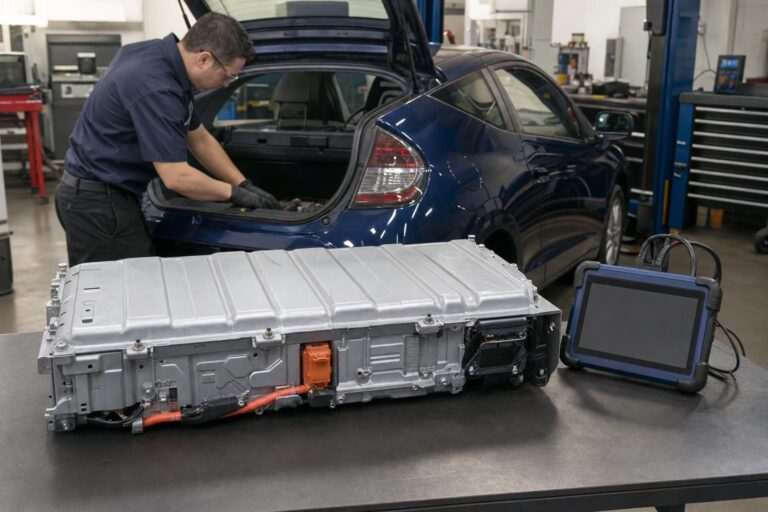
A Toyota Prius hybrid battery cell is the smallest building block of the high-voltage traction pack. In every nickel-metal hydride (NiMH) Prius pack, a single cell has a nominal voltage of 1.2V, six cells are welded in series into a 7.2V module, and those modules are then connected in series to form the full pack. Getting these three levels — cell, module and pack — straight is the first step toward reading voltage correctly, interpreting a low-traction-battery warning, and ordering the right replacement part the first time.
This guide is written for independent hybrid repair shops, parts distributors, fleet maintenance teams and reconditioning businesses outside China who need exact cell, module and pack voltage figures by generation, and who want to connect those numbers to safe diagnostic practice and accurate replacement sourcing for Prius, Camry Hybrid and Toyota Aqua applications.
Principais conclusões
- One Prius NiMH cell is 1.2V nominal; six cells form one 7.2V module; modules in series form the pack.
- The 2004-and-later Prius (NHW20 onward) uses 28 modules / 168 cells for a rated 201,6 V pack, while the 2001–2003 NHW11 used 38 modules / 228 cells for 273,6 V.
- Later Li-ion Prius variants are documented at roughly 207.2V ou 222V nominal, with ~3.7V cells — a different chemistry that is not interchangeable with NiMH.
- Boosted inverter voltage (up to ~600V DC) is not the battery’s own nominal voltage; keep the two figures separate.
- Always verify chassis code, model year, chemistry, module count, pack voltage and enclosure before ordering any cell, module or full-pack replacement.
Cell, module and pack: why the terms get confused in search
Search queries mix these words freely — “prius battery cell,” “prius battery pack voltage” and “prius high voltage battery” often describe the same component at different scales. Being precise avoids ordering mistakes:
- Cell — the chemical unit. In a Prius NiMH battery, one prismatic cell is 1.2V nominal.
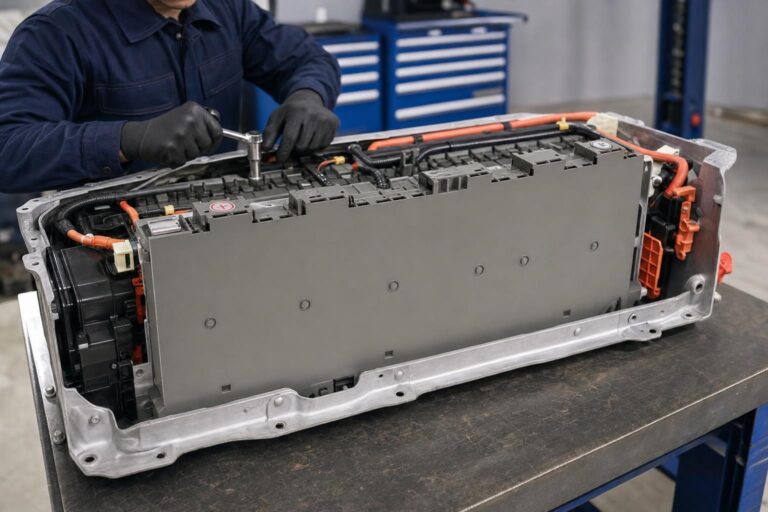
- Module — six 1.2V cells joined in series inside a single sealed case, giving 7.2V. Modules are what most repair shops physically handle and swap.
- Pack (HV or traction battery) — all modules connected in series, plus the ECU, bus bars, service plug, cooling and enclosure. This is the complete assembly that bolts into the vehicle.
When a technician reports a “bad cell,” they usually mean a weak or imbalanced 7.2V module, because individual 1.2V cells inside a module are not separately serviceable in normal practice. According to Toyota hybrid training documentation, six 1.2V NiMH cells are connected in series to form one 7.2V module, as set out in this Toyota hybrid training reference.
NiMH cell and module voltage basics
NiMH chemistry sets the arithmetic for every classic Prius pack, and understanding Prius hybrid battery cell voltage at this level is what makes any later hybrid battery cell replacement decision defensible:
- 1 cell = 1.2V nominal
- 1 module = 6 cells × 1.2V = 7.2V nominal
- Pack = module count × 7.2V
Nominal voltage is a rated average, not a fixed reading. A healthy NiMH module rests somewhat above 7.2V and moves up and down with state of charge, temperature and load. That is why a scan tool shows a voltage band rather than a single number, and why module-to-module voltage spread — not absolute voltage alone — is often the clearer indicator of pack health. When buyers evaluate stock across a gama de produtos de baterias híbridas, these same cell-and-module fundamentals govern whether a part will actually balance correctly in service.
Pack voltage by generation and chassis
The two most important NiMH architectures for buyers are the first-generation NHW11 and the 2004-and-later platform.
2001–2003 Prius (NHW11): 273.6V
The first-generation Prius HV battery uses 38 modules split across two holders, totalling 228 cells, for a rated pack voltage of 273,6 V. This is confirmed in Toyota’s high-voltage battery mechanics training document. NHW11 modules and packs are not interchangeable with later generations.
2004-and-later Prius (NHW20 onward): 201.6V
From the 2004 model year, the Prius HV battery uses 28 modules in series for a rated pack voltage of 201,6 V, totalling 168 cells. This is the architecture most independent shops encounter and the one behind the majority of “prius cell replacement” and “prius battery cell replacement” searches. A Prius hybrid battery specifications-by-generation summary — of the kind documented on the Garantia de qualidade OKACC page — pairs these module and cell counts with the chemistry changes in later generations so buyers can match parts to the correct era.
Later generations and the Li-ion shift
Later Prius generations moved many trims to lithium-ion cells (~3.7V nominal) with different pack voltages. An independent teardown analysis of a dismantled 2017 fourth-generation Prius Li-ion traction battery reports a system nominal voltage of 207.2V with 3.7V cells in a 1P56S configuration built from two 1P28S modules. Other technical documentation lists variants at 222V nominal. Treat later-generation cell and module counts as variant-dependent and, in some cases, proprietary — never assume a Li-ion pack is a drop-in for a NiMH pack, or vice versa.
Boosted system voltage is not the battery’s nominal voltage
One of the most common buyer misunderstandings is confusing the inverter’s boosted operating voltage with the battery pack’s own nominal voltage. The Prius power-control unit can step the DC bus up toward the region of ~600V DC to drive the motor-generators efficiently. That boosted figure describes the inverter output — não the chemistry’s rated pack voltage. A NiMH Prius pack remains 201.6V (or 273.6V on NHW11) regardless of how high the inverter boosts downstream. When you specify or verify a replacement, always use the battery’s rated pack voltage, never the boosted system number.
Reading cell, module and pack voltage during diagnosis
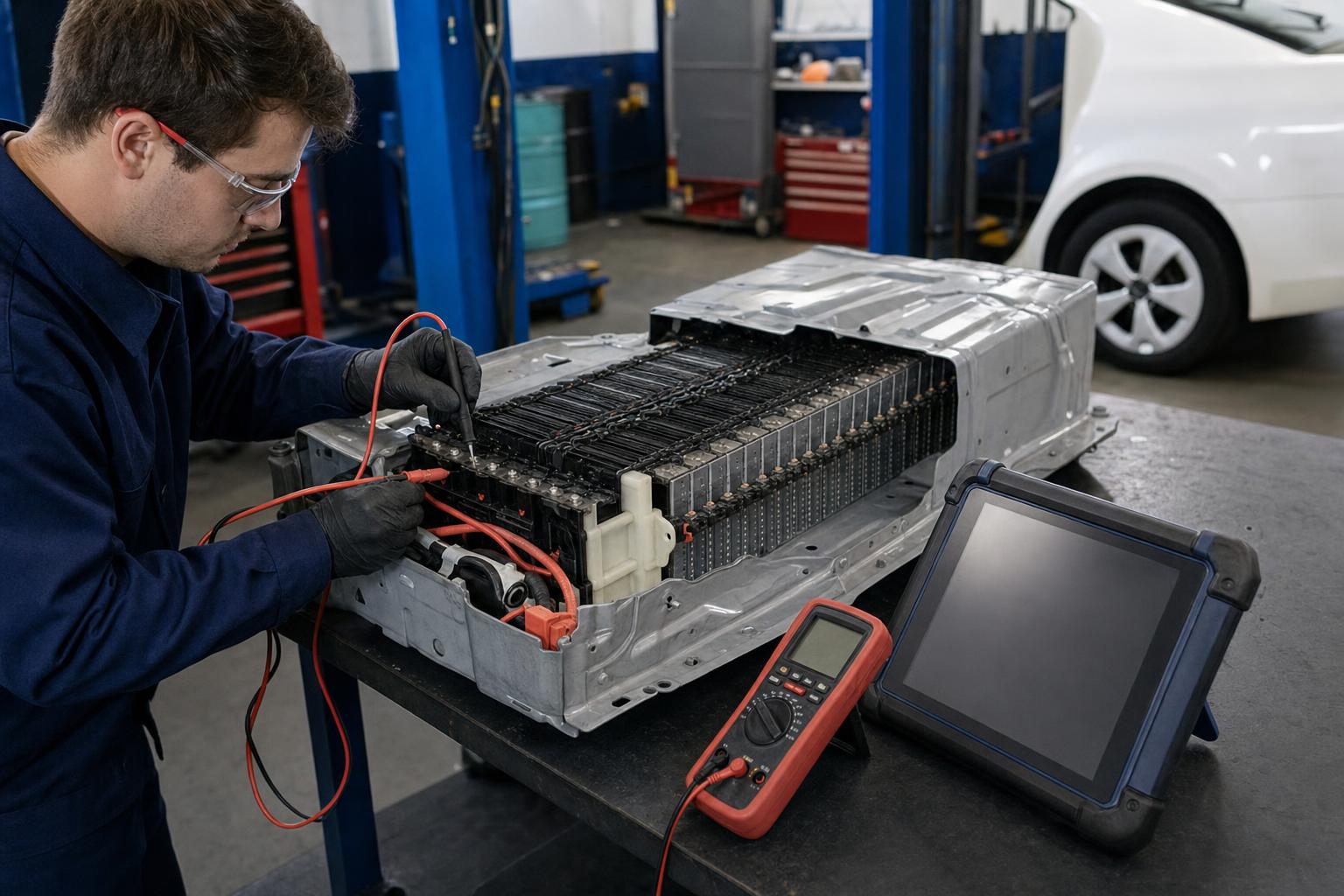
Scan-tool HV battery voltage is read at the pack level, and Toyota diagnostic documentation publishes operating bands that help you judge whether a reading is plausible:
- On the 2ZR-FXE hybrid system, an ignition-ON HV battery voltage operating range of 210.00V to 280.00V is listed in this hybrid battery system reference.
- On the Prius PHEV model, an ignition-ON HV battery voltage operating range of 200.00V to 400.00V is listed in the corresponding PHEV hybrid battery system reference. That wide upper band reflects the boosted-architecture measurement context rather than the chemistry’s rated nominal voltage, so it should not be read as the pack’s own nominal figure.
At the module level, the practical diagnostic signal is balance. Toyota’s battery ECU monitors blocks of modules and flags imbalance. A single weak module can drag block voltage down under load even when the resting pack voltage looks normal. For that reason, experienced shops log module-block voltages across a drive cycle rather than relying on one static reading — the same Toyota hybrid battery cell-voltage spread that reveals which modules are failing.
Nota de segurança: HV battery service involves lethal voltages. Only technicians trained and equipped for high-voltage work should open, probe or handle a traction pack, using the service plug isolation and personal protective equipment specified by qualified procedures. This article is a specification and sourcing reference, not a DIY high-voltage instruction.
Low traction battery warnings and what they indicate at cell level
Searches such as “low traction battery prius,” “traction battery low prius” and “traction battery power low prius” usually describe the same family of symptoms: reduced electric assist, more frequent engine running, a warning message, and eventually a stored code such as the familiar P0A80 hybrid-battery-deterioration family. At the cell and module level, these symptoms typically point to:
- Module imbalance — one or more 7.2V modules aging faster than the rest, widening the voltage spread.
- Capacity loss — NiMH modules holding less charge, so the ECU restricts output to protect the pack.
- Internal resistance rise — aged modules sagging under load even if resting voltage looks acceptable.
These are degradation patterns, not a single fault. A “traction battery power low” message on an older high-mileage pack is usually the ECU reporting that the weakest modules can no longer deliver rated power — a cue to assess the whole pack, not just chase one number.
Toyota Aqua and Camry Hybrid context
The same NiMH cell-and-module logic underpins related Toyota hybrids, which is why queries like “toyota aqua hybrid battery cell voltage,” “aqua battery cell” and “2007 toyota camry hybrid battery cell replacement” cluster alongside Prius searches. These platforms share the 1.2V cell / 7.2V module building block, but module count, pack voltage, enclosure shape and ECU calibration differ by model and chassis. International interest in Aqua (Prius C / NHP10) cell voltage in particular reflects the large population of imported used Aqua vehicles in many markets.
The practical lesson: shared chemistry does não mean shared fitment. A module that is electrically 7.2V in both an Aqua and a 2004-later Prius can still be mechanically and electronically incompatible. Verify by chassis code and part application every time.
Replace a module or the whole pack? Sourcing considerations
Two broad strategies exist, each with different risk profiles for shops and distributors.
| Approach | Mais adequado para | Key risks |
|---|---|---|
| Individual module replacement | Diagnosed single-module failure on an otherwise sound pack; reconditioning workflows | Mixing aged and new modules can re-balance poorly; remaining modules may fail soon after |
| Full-pack replacement | High-mileage packs, multiple weak modules, fleet reliability, minimising repeat visits | Higher part cost; requires correct chassis/chemistry match and enclosure fit |
For professional buyers, the decision usually comes down to the age and condition spread of the existing modules. Replacing one module in a pack where every module is near end of life often leads to a repeat failure. Distributors and fleets frequently standardise on full-pack replacement for predictable turnaround, while reconditioning specialists may stock individual modules for targeted repairs.
Fitment verification checklist before ordering
Before you place an order for a cell, module or full-pack replacement — whether sourcing new Prius hybrid battery cells or a complete assembly — confirm every one of the following against the actual vehicle, not just the model name:
- Chassis code (for example NHW11 vs NHW20 vs later) — drives module count and pack voltage.
- Model year — distinguishes 273.6V vs 201.6V NiMH eras and NiMH vs Li-ion variants.
- Química — NiMH (1.2V cell) vs Li-ion (~3.7V cell); never substitute one for the other.
- Module count and rated pack voltage — e.g. 28 modules / 201.6V for 2004-later Prius.
- Physical enclosure and connector layout — bus bars, service plug position, mounting points.
- ECU/application compatibility — confirm the replacement is specified for the exact application.
- Condition basis — for predictable service life, specify brand-new assemblies, never refurbished, reconditioned, used or remanufactured units whose prior cycling cannot be verified.
When any detail is uncertain, verify by VIN and part application before purchase. Our team can cross-check these details — Solicite um orçamento técnico with the chassis code and model year to hand.
Sourcing a New OEM-spec NiMH Hybrid Battery Replacement
Suprimentos OKACC Nova bateria híbrida NiMH de substituição com especificações OEM units designed to meet OEM specifications for applications including the 2004-and-later Prius platform. These are brand-new assemblies — never refurbished, reconditioned, used or remanufactured — which matters because cell age and prior cycling cannot be inspected visually on a used module. For buyers comparing suppliers, consistent incoming inspection and documented process control are what separate dependable stock from variable salvage. OKACC is an independent manufacturer and is not Toyota OEM, Toyota-affiliated or Toyota-approved.
Perguntas frequentes
What is the voltage of a single Prius battery cell?
A single NiMH Prius battery cell is 1.2V nominal. Six cells in series form one 7.2V module, and those modules in series form the full high-voltage pack.
What is the full Prius battery pack voltage?
The 2004-and-later Prius uses 28 modules for a rated 201.6V pack (168 cells). The 2001–2003 NHW11 used 38 modules for 273.6V (228 cells). Later Li-ion variants are documented at roughly 207.2V or 222V nominal.
What does a “low traction battery” warning mean at cell level?
It usually signals module imbalance, capacity loss or rising internal resistance in aging modules, so the battery ECU limits power to protect the pack. It points to overall pack degradation rather than a single fixed voltage reading.
Is the ~600V figure the Prius battery’s voltage?
No. Up to ~600V DC is the inverter’s boosted operating voltage, not the battery’s nominal voltage. The NiMH pack itself stays 201.6V (or 273.6V on NHW11). Always specify replacements by the battery’s rated pack voltage.
Can I use one module or pack across all Prius model years?
No. Chassis code, model year, chemistry, module count, pack voltage and enclosure all vary. Shared 7.2V module chemistry does not mean shared fitment — always verify by chassis code and part application.
Does the Toyota Aqua use the same cells as the Prius?
The Aqua (Prius C / NHP10) shares the 1.2V cell and 7.2V NiMH module building block, but module count, pack voltage, enclosure and ECU calibration differ. Confirm the exact application before ordering.
Should I replace one module or the whole pack?
Replace a single module only when a sound pack has one diagnosed weak module. On high-mileage packs where many modules are near end of life, full-pack replacement usually prevents repeat failures. For reliability, specify brand-new assemblies rather than used or reconditioned units.
Need application-matched specifications or a verified fitment check for a Prius, Camry Hybrid or Aqua battery? Contact OKACC with the chassis code and model year, and our technical team will confirm the correct replacement before you commit to an order.