Betrouwbare hybride batterijoplossingen































Hoe een hybride accu werkt, defect raakt en vervangen wordt.
Een breed, op bewijs gebaseerd overzicht van hybride batterijtechnologie, hoe NiMH- en lithium-ion-tractiepakketten werken, hoe slijtage te herkennen is en hoe de afweging tussen repareren en vervangen werkt voor professionele inkopers.

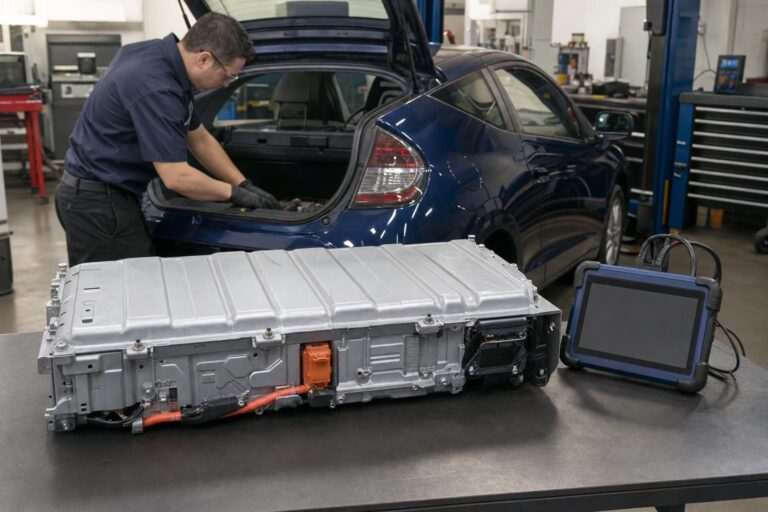
A hybride batterij is the high-voltage traction pack that stores and delivers electrical energy to help drive a hybrid vehicle. It is not the small 12-volt battery under the bonnet. Instead, it is a series-connected assembly of cells, modules, sensors and control electronics that works alongside the petrol engine to move the car, capture braking energy and power the electric motor. For repair shops, distributors and fleet operators, understanding how this pack functions, degrades and is serviced is the foundation for every sourcing and replacement decision that follows.
This guide is a broad educational overview, not a teardown manual. It explains what a hybrid traction battery does, the difference between NiMH and lithium-ion chemistries, how to recognise genuine cell degradation versus a cooling or electronics fault, and how the repair-recondition-replace decision path generally works before you commit to sourcing a replacement pack.
Belangrijkste conclusies
- A hybrid battery is a high-voltage traction pack made of modules, cells, a battery management system (BMS) and a cooling circuit — not the 12-volt starter battery.
- A “check hybrid system” warning does not automatically mean the cells are dead; cooling, sensors and control electronics must all be checked first.
- Replacing a hybrid battery pack involves lethal high voltage and requires trained, certified technicians with insulated tools and protective equipment.
- When sourcing a replacement, confirm cell provenance, test data, exact model-year fitment, warranty terms and dangerous-goods packaging.
What a hybrid battery is and what it does in the drivetrain
In a hybrid drivetrain, the traction battery acts as an energy buffer. During acceleration it supplies electrical power to the motor-generator to assist or replace the petrol engine. During braking or coasting it recovers kinetic energy through regenerative braking and stores it as charge. At idle or low load it can allow the engine to switch off entirely, cutting fuel use and emissions.
Because the pack cycles constantly — charging and discharging many times per journey — it is engineered for durability rather than the single deep discharge of a conventional battery. The hybrid control system manages state of charge within a narrow window (often keeping the pack partly charged) to extend service life and maintain consistent power delivery. This is why a healthy hybrid battery rarely reaches full charge or full depletion in normal use.
How a hybrid battery pack works: modules, cells, BMS and cooling
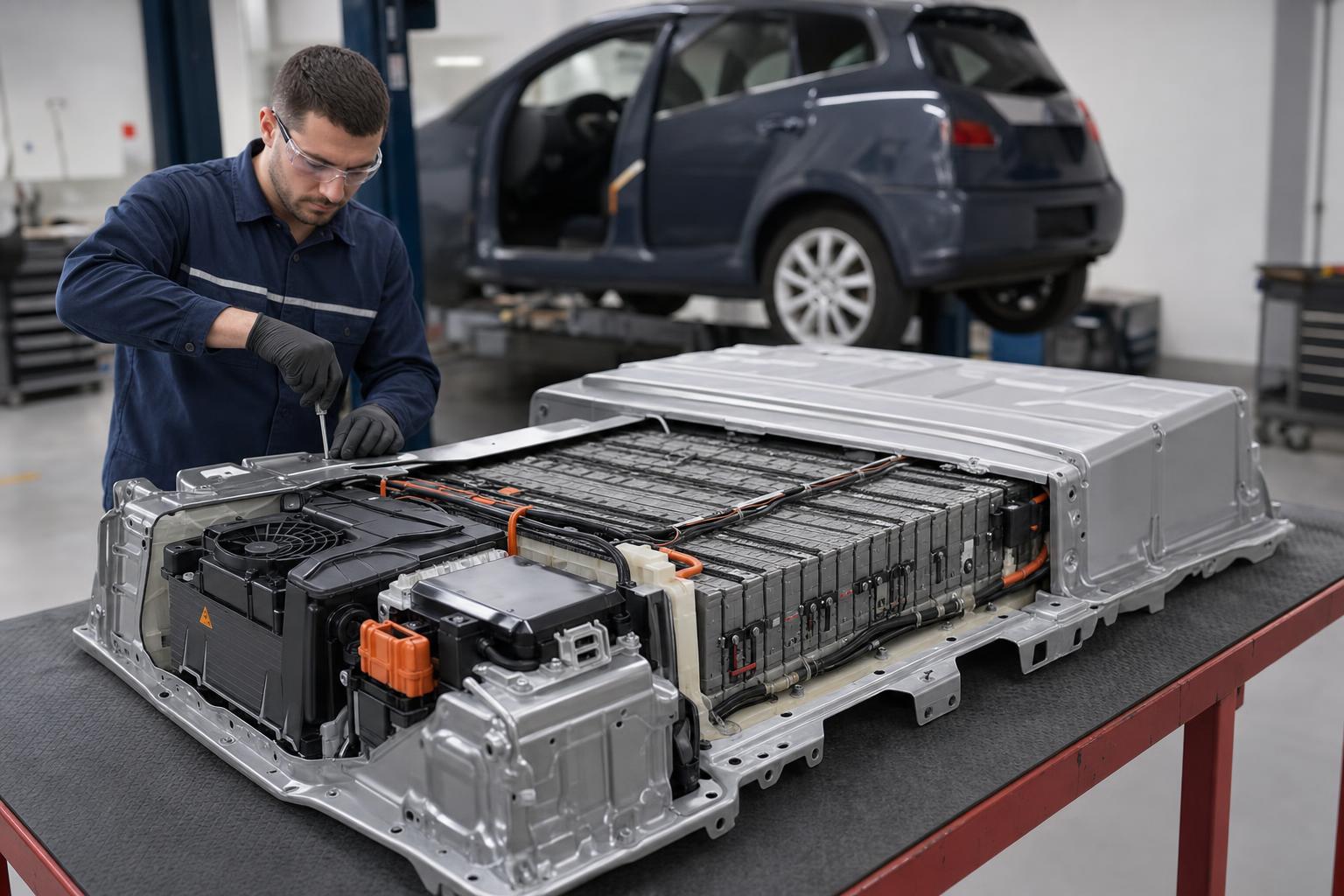
A hybrid traction pack is built up in layers. Individual cells are grouped into modules, and modules are connected in series to reach the pack’s operating voltage. A typical NiMH hybrid pack runs at a nominal voltage in the low-to-mid hundreds of volts, which is why the assembly is treated as a high-voltage safety hazard.
Three subsystems keep the pack working:
- Battery management system (BMS): Electronics and software that monitor voltage, current, temperature and state of charge, balance the modules, and communicate faults to the vehicle. NHTSA guidance notes that traction batteries include this management hardware and software, meaning the pack is far more than a box of cells.
- Koelsysteem: Fans, ducts and vents that draw air (or in some designs, liquid) across the modules to keep temperature even. Uneven or blocked cooling is a leading cause of premature module failure.
- Sensors and terminals: Temperature and voltage sensors, plus high-current bus bars and connectors that must stay clean and corrosion-free to report accurate data.
Understanding this architecture matters commercially: a fault flagged by the vehicle can originate in any of these subsystems, not only in aged cells.
NiMH vs lithium-ion hybrid traction batteries
Two chemistries dominate the hybrid market, and buyers should understand the general trade-offs before stocking or specifying replacements.
Nickel-metal hydride (NiMH) has been the workhorse chemistry for conventional hybrids for many years. It is robust, tolerant of a wide temperature range, and has a long, well-understood field history. Many high-volume hybrids — including much of the Toyota hybrid fleet — were built around NiMH packs, which keeps demand for NiMH replacements strong across the aftermarket.
Lithium-ion (Li-ion) offers higher energy density and lower weight, and appears in newer hybrids, plug-in hybrids and full EVs. It generally requires more sophisticated thermal and charge management. Some models switched chemistry across generations, so a vehicle badged the same way in different years can carry a different pack type.
| Factor | NiMH | Lithium-ion |
|---|---|---|
| Typical use | Conventional hybrids, long field history | Newer hybrids, PHEVs, EVs |
| Energy density | Lager | Hoger |
| Gewicht | Heavier for same energy | Lighter |
| Thermal tolerance | Broad, forgiving | Tighter management needed |
| Aftermarket demand | Very high on legacy fleets | Growing with newer models |
For distributors, the practical point is that chemistry and fitment are tied to specific model years. Never assume a replacement designed for one generation fits another simply because the model name is the same.
Common warning signs of hybrid battery degradation
Hybrid batteries rarely fail overnight. They usually decline gradually, and the symptoms often reach a driver or fleet manager before a hard fault code appears. Typical signs include:
- Noticeable drop in fuel economy as the engine runs more to compensate for weak electrical assist.
- Erratic or rapidly swinging state-of-charge display, or a battery gauge that jumps between high and low.
- Reduced electric-only or engine-off operation.
- The internal cooling fan running loudly or constantly.
- A “check hybrid system” or master warning light, or a stored diagnostic trouble code.
- Weaker acceleration or the engine straining under loads it previously handled easily.
These symptoms indicate the pack needs investigation — not that the whole pack necessarily needs replacing.
Diagnosing a battery fault versus a cooling, sensor or electronics problem
This is the single most important step for professional buyers, because it separates a genuine cell-failure replacement from a cheaper repair. As industry repair guidance explains, and consistent with NHTSA’s point that the pack includes management hardware and software, a warning light does not by itself prove the cells are finished.
A structured diagnosis generally follows three stages:
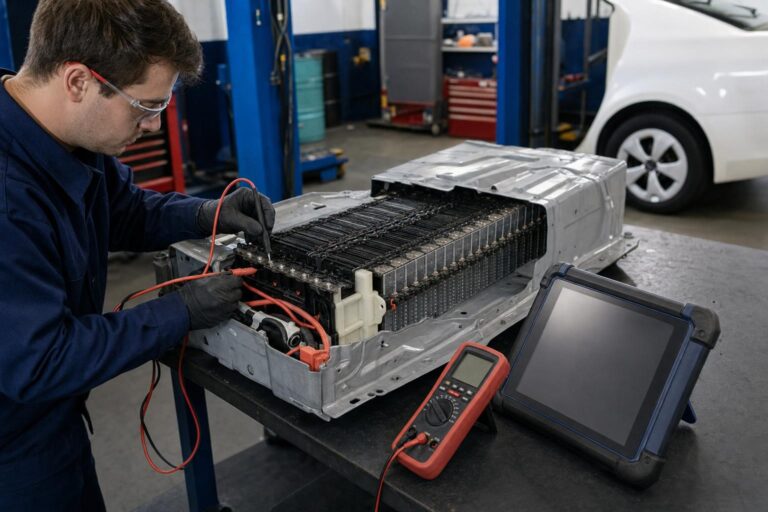
- Scan live data: Read the control unit for block or module voltages, temperature readings and stored codes. Uneven block voltages point toward a weak module; uniform readings with a temperature or communication fault point elsewhere.
- Physical inspection: Check cooling ducts, fans and vents for dust or blockage, and inspect terminals and connectors for corrosion or loose joints. A clogged cooling path can cause one section to overheat and age faster than the rest.
- Controlled load testing: Test under load to see whether a single weak module is dragging the pack down or whether capacity has fallen across the whole assembly.
The outcome of this process determines whether the correct action is a targeted repair, a full pack replacement, or a fix to the cooling or sensor system entirely. Skipping it risks replacing a healthy pack because of a failed sensor.
Toyota hybrid battery basics
Because Toyota built so many of the world’s hybrids, the Toyota hybrid battery is often the reference point for aftermarket demand. Historically, most Toyota and Lexus hybrids used NiMH traction packs, with lithium-ion appearing on selected later models. This long-standing NiMH base is a major reason the replacement market for these packs remains active worldwide.
Before quoting or ordering any replacement, confirm the warranty position first. In the United States specifically, a federal minimum requires hybrid batteries to be covered for at least eight years or 100,000 miles, as noted by AutoZone’s hybrid battery guidance. Reporting on Toyota and Lexus coverage indicates that many model-year 2020 and later hybrid batteries are cited as covered for 10 years or 150,000 miles, whichever comes first. Warranty entitlement varies by market and model year, so always verify the vehicle’s actual coverage per the customer’s jurisdiction before positioning a replacement as out of warranty.
OKACC supplies New OEM-spec NiMH Hybrid Battery Replacement packs designed to meet OEM specifications. OKACC is an independent manufacturer and is not Toyota, genuine Toyota, or Toyota-affiliated; that distinction matters when you communicate options to a customer.
Repair, recondition or replace: how the decision path works
Once diagnosis confirms the battery itself is at fault, three general paths exist. Each suits a different situation, and the right answer depends on the vehicle’s age, mileage, value and intended service life.
- Repair (module-level): Replacing one or a few failed modules and rebalancing the pack. This can be cost-effective in the short term but leaves aged modules alongside the new ones, which may drive an uneven degradation curve.
- Recondition: Discharging and recharging cycles intended to recover some capacity. It may restore short-term performance but does not add new cells, and results vary with the pack’s underlying condition.
- Replace with a new pack: Installing a complete new battery assembly. This resets the pack to a known, uniform starting condition and is generally the most predictable choice for vehicles expected to stay in service for years or for fleets that need consistent uptime.
When you weigh these routes, matching the correct replacement to a specific application is essential. You can review OKACC’s Productassortiment hybride accu's to see how fitment and provenance questions are addressed across specific model applications.
What replacing a hybrid battery pack involves — and why it is not a DIY job
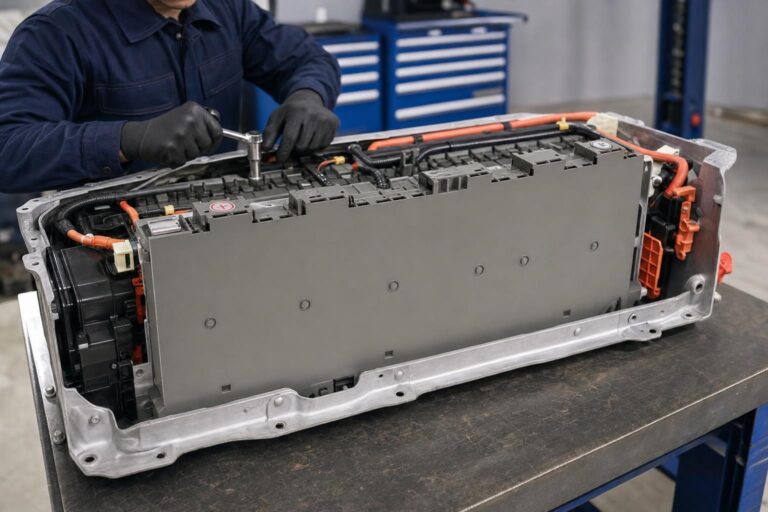
Naar replace a hybrid battery pack at a high level means safely de-energising the high-voltage system, disconnecting the service plug, removing the old assembly, fitting a fitment-matched replacement, reconnecting the pack and cooling circuit, and clearing fault codes so the BMS re-initialises correctly.
This is emphatically not a task for untrained persons. A hybrid traction pack carries voltages that can cause serious or fatal electric shock. AutoZone notes that the work requires insulated Class 0 1000-volt rubber gloves, eye protection, insulated tools and proper training or certification. Professional shops follow lock-out procedures, verify zero energy before touching conductors, and handle the pack with the correct lifting and isolation equipment. For B2B buyers, this reinforces why replacement volumes flow through qualified workshops rather than end users, and why supplier support and clear documentation carry real value.
Sourcing a new OEM-spec replacement pack: what to verify
When you evaluate any replacement source, the goal is to confirm exactly what you are buying and that it will fit and perform in the target vehicle. Use this checklist before committing an order:
- Cell provenance: Confirm whether cells are genuinely new or built on a used core. OKACC packs are brand-new assemblies, not refurbished or remanufactured.
- Test data: Ask what capacity, internal-resistance and module-balancing test data is available for the pack before shipment.
- Exact fitment: Match the specific model year and variant, not just the model name, because chemistry and connectors changed across generations. Always confirm fitment against verified data.
- Garantievoorwaarden: Get the exact warranty length and what it covers in writing.
- Packaging and shipping: Confirm the high-voltage pack is packaged and shipped as a regulated dangerous good, with correct documentation for cross-border transport.
To understand how each pack is verified before shipment, review the OKACC kwaliteitsborging process, which covers the capacity and balancing checks buyers should expect.
Warranty and regulatory basics to confirm before buying
Two regulatory areas repeatedly catch out first-time hybrid battery buyers. The first is warranty entitlement: because coverage can run to 8 years/100,000 miles under the U.S. federal minimum and up to 10 years/150,000 miles on some newer Toyota and Lexus vehicles, always check whether the customer’s pack may still be covered before selling a replacement. The second is transport: hybrid traction batteries are regulated dangerous goods and must be packaged, labelled and documented accordingly for road, sea or air movement. Clarify who is responsible for compliant packaging and paperwork at the point of order.
For markets outside China, confirm both the destination’s import requirements and the supplier’s ability to provide compliant shipping documentation. When you have a target vehicle and volume in mind, you can Vraag een technische offerte aan with your fitment details. If any documentation or delivery point is unclear, you can also neem contact op met OKACC to discuss fitment, compliance and delivery for your market.
Veelgestelde vragen
Is the hybrid battery the same as the car’s 12-volt battery?
No. The hybrid battery is the high-voltage traction pack that helps drive the vehicle and capture braking energy. The 12-volt battery separately powers accessories, electronics and system start-up. They are distinct components with different roles.
Does a “check hybrid system” warning mean I need a new battery?
Not necessarily. NHTSA guidance notes that a traction battery includes management hardware and software, so the warning can come from cooling, sensors or control electronics rather than dead cells. A proper diagnosis with live data, physical inspection and load testing should confirm the cause first.
What is the difference between NiMH and lithium-ion hybrid batteries?
NiMH is the long-established, robust chemistry used in most conventional hybrids, with a broad temperature tolerance. Lithium-ion offers higher energy density and lower weight and appears in newer hybrids and plug-in hybrids, but needs tighter thermal and charge management. Fitment depends on the exact model year.
Can a hybrid battery be repaired instead of replaced?
Sometimes. Module-level repair or reconditioning can restore short-term performance if only part of the pack is weak. However, aged modules remaining in the pack can degrade unevenly. A complete new pack gives the most predictable, uniform starting condition, which often suits fleets and vehicles kept in long service.
Why can untrained people not replace a hybrid battery pack safely?
Because the pack carries lethal high voltage. AutoZone notes the work requires insulated Class 0 1000-volt gloves, eye protection, insulated tools and proper training or certification. Qualified technicians de-energise and verify the system before handling any high-voltage conductor.
What should I verify before ordering a replacement pack?
Confirm the cells are genuinely new, ask for capacity and balancing test data, verify exact model-year fitment, get the written warranty term, and confirm the pack ships as a compliant dangerous good with correct documentation for your market.
Are OKACC replacement packs new or refurbished?
OKACC supplies brand-new NiMH hybrid battery replacement packs engineered to OEM specification standards. They are not refurbished, reconditioned, used or remanufactured. OKACC is an independent manufacturer and is not Toyota-affiliated.