Trusted Hybrid Battery Solutions































P0A80 on a Prius: Decoding the Hybrid Battery Code and Sourcing a Compliant Replacement
P0A80 on a Prius points to a hybrid battery pack that no longer holds a balanced charge. This guide explains the code, related P3000-series faults, compatibility checks and how to source a compliant replacement pack.

P0A80 on a Toyota Prius means “Replace Hybrid Battery Pack”: the vehicle’s battery ECU has detected that one or more modules in the high-voltage NiMH pack can no longer hold or deliver a balanced charge. The same code appears on the Toyota Aqua and on Lexus hybrids, and it is frequently stored alongside a P3000-series code that names the specific weak block. For repair shops, importers and fleet buyers, P0A80 is usually a sourcing decision rather than a simple sensor reset: the pack, or at least its failing modules, needs replacing with a unit that matches the original chemistry, voltage and connector layout.
This guide explains what P0A80 and its related codes indicate, how to confirm compatibility before you buy, and how to evaluate a replacement supplier so the repair holds up in service.
Key takeaways
- P0A80 (“Replace Hybrid Battery Pack”) is a battery-condition code, not a wiring fault, and appears on Prius, Aqua and Lexus hybrids.
- P3000 is the parent hybrid-battery code, while P3011–P3024 identify the specific weak block; read all stored codes before sourcing parts.
- Confirm generation, chemistry (NiMH), pack voltage and connector layout by VIN before ordering any replacement.
- A compliant new NiMH pack, correctly balanced and installed by a qualified technician, is the durable fix for a genuine P0A80.
- High-voltage service must follow OEM safety procedure; this is not a DIY repair.
What P0A80 and its related codes actually mean
P0A80 is a generic OBD-II hybrid diagnostic trouble code (DTC) that Toyota and Lexus use to signal that the hybrid battery pack has degraded beyond the system’s acceptable limits. The full descriptor is “Replace Hybrid Battery Pack.” It is set by the battery ECU when it detects excessive imbalance between the series-connected modules — typically when one block’s voltage sags under load or recovers abnormally slowly compared with the others.
Because the code is written the same way across the Toyota family, it reads identically whether the vehicle in front of you is a Toyota Prius, a Toyota Aqua or a Lexus hybrid. It is often mistyped as “poa80” because the zero after the P is misread as the letter O; the correct code uses a zero (P-0-A-8-0). The meaning is identical regardless of spelling.
How P0A80 relates to the P3000 series
P0A80 rarely stands alone. It is normally accompanied by a P3000-series code that pinpoints the problem:
- P3000 — the general “battery control system” malfunction code; often the parent code stored together with P0A80 on the same scan report.
- P3006 — voltage imbalance detected across blocks.
- P3011 through P3024 — each of these identifies a specific block number (Block 1, Block 2, and so on) that has fallen out of range. The following are representative examples from that range rather than an exhaustive list: P3011, P3012, P3013, P3014, P3015, P3016, P3019, P3020, P3021, P3022, P3023 and P3024, each mapping to an individual pair of modules inside the pack. Intermediate codes such as P3017 and P3018 belong to the same block-fault sequence.
Reading the block-specific code tells you which section of the pack triggered the fault, which is useful diagnostic context. It does not, on its own, prove that only that block is failing — imbalance is a system condition, and neighbouring blocks are often close behind.
Adjacent battery-system codes worth checking
Several related codes point to the same subsystem and frequently appear during or after a hybrid battery fault:
- P0AA6 — hybrid battery voltage isolation fault; indicates a possible loss of insulation between the high-voltage system and chassis ground and must be investigated carefully.
- P0A7F — hybrid battery pack deterioration.
- P0A80‘s cousins P0A82, P0AC0, P0AFA and P0A1F relate to battery cooling, performance and control-circuit conditions. (Note that generator-side codes such as P0A92, “Hybrid Generator Performance,” concern the generator rather than the battery and should not be grouped with battery-condition faults.)
Always retrieve the full freeze-frame and every stored code before deciding on parts. A P0AA6, in particular, changes the scope of the job because it concerns high-voltage isolation rather than simple capacity loss.
How to confirm vehicle and battery compatibility
The single most common sourcing mistake with P0A80 repairs is ordering a pack that fits a different Prius generation. Before you buy anything, confirm the following from the VIN and a physical inspection:
- Model and generation. A P0A80 on a 2010 Toyota Prius (third-generation, ZVW30) needs a different pack from a first- or second-generation Prius, a Prius c, a Prius v/+ or a Prius Plug-in. The Aqua and various Lexus hybrids use their own pack designs.
- Chemistry. Most Prius liftback packs are nickel-metal hydride (NiMH). Some variants — including certain fourth-generation and Plug-in models — use lithium-ion. OKACC’s replacement scope covers NiMH packs, so vehicles with factory lithium-ion packs require separate confirmation before any quotation. A replacement must match the original chemistry and the vehicle’s battery-management expectations.
- Nominal voltage and module count. Confirm the number of modules and the pack’s nominal voltage. Mixing module counts or voltages is not a valid repair.
- Connector, bus-bar and duct layout. Cooling-duct geometry, the service plug (safety plug) position and the main connector must match so the pack seats and cools correctly. The service plug itself is often generation-specific and may need to be transferred from the old pack or supplied with the new one — confirm which applies before fitting.
- ECU and firmware context. The battery ECU may be integrated with the pack or separate depending on generation; know which applies before ordering.
Match these against the specifications shown in the OKACC hybrid battery product range and cross-check the part against your VIN interpretation. If any attribute is unclear, resolve it before purchase rather than after the pack arrives.
Replacement options and sourcing considerations
Once a genuine P0A80 is confirmed, there are a few practical routes. Each has trade-offs for a professional buyer:
| Option | What it involves | Buyer considerations |
|---|---|---|
| Complete new pack | Replace the entire high-voltage battery with a new unit built to OEM specifications. | Most predictable outcome for imbalance codes; simplest to warranty; highest unit cost. |
| Module-level repair | Replace only the block flagged by the P3000-series code. | Lower parts cost but higher risk of a repeat fault as adjacent aged modules follow; needs precise matching and balancing. |
| Reconditioned/used pack | A pack of unknown remaining life reused from another vehicle. | Unpredictable service life and warranty; generally the weakest option for professional resale or fleet duty. |
OKACC positions its packs as new NiMH hybrid battery replacements engineered to OEM specifications — not refurbished, reconditioned or used units. For shops that resell repairs or run vehicles in daily service, a brand-new pack removes the uncertainty of mixed-age modules, which is the usual reason a module-level fix returns with the same code a few months later.
When comparing suppliers, look past headline price to landed cost: unit price, freight, dangerous-goods handling, import duties, core-charge policy (if any) and the practical warranty you can actually claim across a border.
Quality control and supplier evaluation checklist
A hybrid battery is a safety-critical, high-voltage component. Treat supplier evaluation the way you would for any regulated part. Ask each candidate supplier to document the following:
- Cell/module sourcing and grading. How are modules selected and matched for capacity and internal resistance before assembly?
- Balancing and final test. Is every finished pack charge/discharge tested and voltage-balanced, with a record retained?
- Traceability. Can each pack be traced to a production batch and test record via a serial number?
- Chemistry and specification match. Is the pack confirmed as NiMH (or Li-ion where applicable) at the correct nominal voltage and module count for the target VIN?
- Packaging and dangerous-goods compliance. Are packs shipped in compliant UN-approved packaging with the correct documentation?
- Warranty terms in writing. Duration, what is covered, and the exact claim procedure for an international buyer.
You can review OKACC’s documented process on the OKACC quality assurance page and request the specific test evidence relevant to your order. A supplier that cannot produce per-pack test data is difficult to stand behind when a fleet customer returns with a fault.
Installation, diagnostics and high-voltage safety
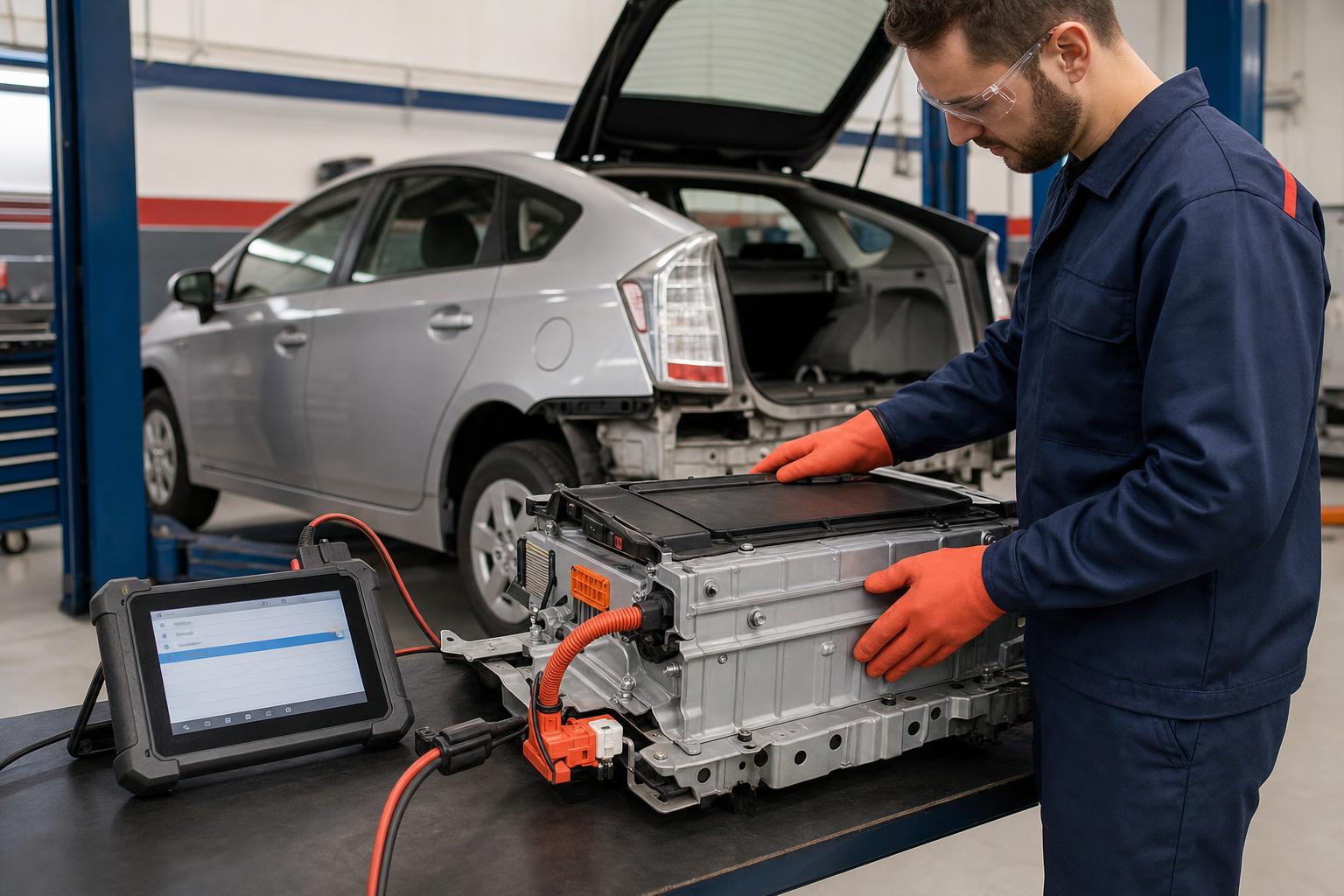
P0A80 diagnosis and battery replacement involve orange high-voltage cabling and a service plug that isolates the pack. This work must be performed by a technician trained in high-voltage hybrid service using the correct personal protective equipment and OEM isolation procedure. It is not a DIY job, and this guide does not provide step-by-step high-voltage instructions.
At a professional level, a sound P0A80 workflow looks like this:
- Confirm the code set. Retrieve P0A80 plus any P3000-series, P0AA6, P0A7F and related codes, with freeze-frame data.
- Check the 12V auxiliary battery. Verify auxiliary battery voltage and health first, because low auxiliary voltage can produce spurious hybrid-system codes and complicate P0A80 confirmation.
- Rule out contributors. Check the battery cooling fan and duct for blockage or dust, inspect the high-voltage connections and verify there is no isolation fault (P0AA6) before assuming simple capacity loss.
- Verify with block voltages. Use Toyota-compatible diagnostic software to review individual block voltages and confirm the imbalance the code reports.
- Replace with a matched pack. Fit the correct new pack, transfer or fit the service plug and connectors per procedure, and ensure the cooling path is clean.
- Clear codes and road-test. Clear DTCs, drive the vehicle through charge/discharge cycles and re-read block data to confirm the fault does not return.
Skipping the cooling and isolation checks is the most common reason a “new battery” appears to fail early — the underlying cause was airflow or an isolation issue, not pack capacity.
Warranty, logistics and after-sales questions
For cross-border buyers, the commercial terms matter as much as the part. NiMH hybrid batteries (UN 3496) are regulated as dangerous goods for sea transport under the IMDG Code maintained by the International Maritime Organization (IMO), but are generally not restricted for air transport when protected against short circuit, per IATA dangerous-goods guidance. Exact classification depends on the pack chemistry and the transport mode, so confirm with your supplier which mode applies, what documentation travels with the shipment, and whether your destination has additional import requirements.
Before placing an order, settle these points in writing:
- Warranty length and exactly what triggers a valid claim.
- Who bears return-freight and dangerous-goods handling if a warranty claim is approved.
- Lead time, packaging standard and how packs are protected in transit.
- Technical support available to your installers if a code persists after fitting.
If you need model-specific specifications or a formal offer, you can request a technical quotation with your VIN and target vehicle details.
Frequently asked questions
Does P0A80 always mean I must replace the whole hybrid battery?
P0A80 literally means “Replace Hybrid Battery Pack,” and it is set because module imbalance has exceeded the system’s limits. Confirm the code with block-voltage data and rule out cooling or isolation faults first, but a genuine P0A80 is a battery-condition problem that a matched replacement pack resolves.
What is the difference between P0A80 and P3000 on a Prius?
P3000 is the general hybrid battery control-system code and is often the parent fault, while P0A80 specifically instructs that the pack be replaced. The P3011–P3024 codes stored alongside them identify which internal block triggered the imbalance.
Is “poa80” the same code as P0A80?
The code itself is always P0A80. “poa80” is simply a misreading in search or speech, where the number zero and the letter O are confused; there is no separate “poa80” code. The correct code is P-0-A-8-0, and its meaning does not change.
Does the same code apply to the Toyota Aqua and Lexus hybrids?
Yes. P0A80 is used across Toyota and Lexus hybrids, so the code indicates the same battery-condition fault on an Aqua or a Lexus. The pack design, chemistry and fitment differ by model, so always source the part that matches the specific VIN.
Can I fix P0A80 by replacing only the block named by the P3000 code?
You can, but it carries risk. The named block may be the weakest, yet adjacent modules of the same age often follow. Module-level repairs are prone to a repeat P0A80 or P3000 code, which is why many professional buyers fit a complete new pack.
Should P0AA6 be treated differently from P0A80?
Yes. P0AA6 indicates a high-voltage isolation (insulation) fault rather than simple capacity loss. It must be investigated by a qualified high-voltage technician before any part is fitted, as it can point to a safety issue in the pack or wiring.
How do I confirm a replacement pack fits a 2010 Prius?
Verify the generation from the VIN, confirm the chemistry (NiMH for most third-generation liftback Priuses), and match the nominal voltage, module count and connector and cooling-duct layout. If any specification is unclear, resolve it with your supplier before ordering.
Requesting a technical quotation
P0A80 turns quickly from a diagnostic reading into a parts decision, and the quality of that decision depends on matching the right pack to the exact vehicle. Share your VIN, model year and the full list of stored codes so specifications can be confirmed against your vehicle. To discuss fitment, documentation and terms, contact OKACC and provide the vehicle details above for an accurate, model-specific response.